Shigeru Miyamoto has revealed that Nintendo sometimes develops or revives games with its movie plans in mind. The process also works in reverse: ideas created for games can influence how Nintendo characters are presented on screen.
The clearest examples are Star Fox, Yoshi and the Mysterious Book and Princess Peach: Showtime!. However, Miyamoto described the relationship as case by case, not as a rule requiring every Nintendo game to become a film tie-in. The strategy is better understood as flexible cross-media planning that connects character visibility, game availability and long-term intellectual-property growth.
Key Takeaways:
- Nintendo sometimes considers movie characters when selecting game projects.
- At least three games have been linked to the two Mario films.
- Games can influence films as well as respond to them.
- Remakes can introduce established characters to younger audiences.
- Gameplay-led development remains important despite closer media co-ordination.
What Is Miyamoto’s Nintendo Game-Movie Strategy?
Miyamoto’s Nintendo game-movie strategy connects selected software projects with the company’s film and visual-content plans. When a character is expected to receive greater exposure in a movie, Nintendo may decide that audiences should also have a current game featuring that character.
In his reported Famitsu comments, Miyamoto said he does not personally decide Nintendo’s entire software line-up. Instead, some decisions arise from a particular need, such as ensuring Fox McCloud or Yoshi has an accessible game when appearing in a major film.
The relationship is not limited to promotional timing. It may influence which franchise is revisited, whether an older title is remade and how a character is portrayed across different media.
Miyamoto summarised the approach by saying it “varies by case”. That qualification is important: it indicates a flexible development relationship, not a company-wide requirement that cinema must determine every game.
Why Is Nintendo Connecting Its Games And Movies More Closely?
Movies can reach families and general entertainment audiences who may not own a console or follow gaming announcements. Games then provide those viewers with a longer, interactive way to experience the characters they encountered at the cinema.
Nintendo president Shuntaro Furukawa has officially described films and videos as forms of entertainment with “great synergy with games”.
The company’s corporate strategy briefing summary says visual content can expand the number of Nintendo fans and encourage them to take an interest in its games. Miyamoto added that linear video entertainment could become a long-term asset alongside Nintendo’s interactive work.
Reasons For Closer Co-ordination
- Films create additional contact points with Nintendo characters.
- Related games give movie audiences somewhere to continue the experience.
- Screen appearances can renew interest in less active franchises.
- Consistent character development can strengthen recognition across media.
- Wider collaborations allow Nintendo to reach a global entertainment market.
The underlying purpose is therefore broader than selling one game beside one film. Nintendo is building longer relationships between audiences, characters and interactive entertainment.
Which Nintendo Games Best Demonstrate Miyamoto’s Strategy?
At least three titles illustrate how Nintendo’s movies and games can influence one another. Their connections are not identical, which supports Miyamoto’s description of a case-by-case model.
Star Fox And Fox McCloud’s Film Appearance
Miyamoto reportedly said discussions about including Fox McCloud in The Super Mario Galaxy Movie created a specific desire for a new Star Fox game.
The resulting Star Fox is a cinematic reimagining of Star Fox 64, known as Lylat Wars in Europe. It launched exclusively for Nintendo Switch 2 on 25 June 2026, with new fully voiced dialogue, an orchestral soundtrack, online features and a visual overhaul. The UK digital price was listed as £41.99.
Nintendo’s own announcement explicitly connected the release with moviegoers seeing Fox on screen, reinforcing the relationship described by Miyamoto.
Why Was Yoshi And The Mysterious Book Developed?
Miyamoto said Yoshi’s role in The Super Mario Galaxy Movie was decided early enough for Nintendo to begin developing a corresponding game.
Yoshi and the Mysterious Book launched for Nintendo Switch 2 on 21 May 2026. It gave viewers a current, dedicated Yoshi adventure soon after the film’s April release, rather than directing them only towards older software.
The timing supports a central part of the strategy: when a character receives major exposure, Nintendo wants an accessible game that demonstrates the qualities interactive entertainment can offer.
Princess Peach: Showtime! And Two-Way Influence
Princess Peach: Showtime! Demonstrates the opposite direction of influence. Miyamoto said production on the first Mario film and the Peach game began at around the same time.
According to the translated interview, the existence of a more active Peach-led game prompted discussions about making Peach more energetic in The Super Mario Bros. Movie. This does not establish the game as the only influence on her film characterisation, but it shows that creative ideas can move from software into cinema.
Three Reported Examples
| Game | Movie Connection | Direction Of Influence |
| Star Fox | Fox appeared in The Super Mario Galaxy Movie | Film planning encouraged a game project |
| Yoshi and the Mysterious Book | Yoshi had an early confirmed film role | Film planning prompted a current Yoshi game |
| Princess Peach: Showtime! | Peach’s game and first film overlapped in production | Game development informed film discussions |
Together, the three examples show selection, timing and characterisation working differently within the same cross-media strategy.
How Does Influence Move Between Nintendo Games And Films?
The influence operates in two directions. Movie-to-game planning concerns character visibility and software availability, while game-to-movie influence concerns ideas, personality and presentation.
How The Two-Way Model Works
| Direction | Possible Effect | Confirmed Example |
| Film to game | Reviving a franchise, commissioning a title or timing a release | Star Fox and Yoshi and the Mysterious Book |
| Game to film | Informing a character’s activity, abilities or screen personality | Princess Peach: Showtime! |
| Shared audience planning | Preparing for film viewers who may later try a game | Super Mario Bros. Wonder |
| Wider IP planning | Extending characters through films, events and merchandise | Nintendo’s visual-content programme |
Miyamoto said Nintendo would continue seeking a “positive relationship” between games and other media initiatives. That wording suggests collaboration rather than a rigid production pipeline in which one medium always leads the other.
There is also no evidence that movie scripts routinely dictate level design, game mechanics or control systems. Film plans may influence which project receives attention without replacing the gameplay experimentation required to make it successful.
Why Are Remakes Important To Miyamoto’s Wider Nintendo Strategy?
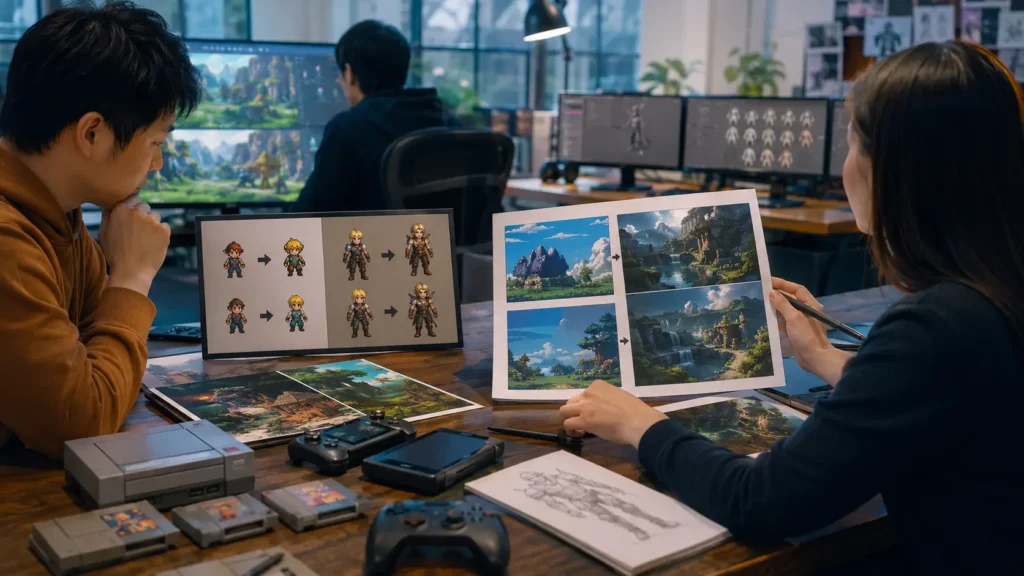
Miyamoto has linked remakes with accessibility and future franchise development. In the translated Famitsu comments, he argued that many people move on from games after roughly five years, while younger players may have little opportunity to experience titles released ten years earlier.
Modern remakes can therefore restore access while refreshing how an older property is presented.
What Remakes Can Achieve
- Improve visuals, controls and technical performance.
- Reintroduce established characters to a new generation.
- Make older stories available on current hardware.
- Test continuing interest in a dormant series.
- Build recognition before later games or media projects.
- Preserve awareness of Nintendo’s back catalogue.
Miyamoto reportedly said that helping people discover original games can lead to “future developments”, explaining why Nintendo has actively pursued remakes.
This approach is already visible in Star Fox and the confirmed 2026 Nintendo Switch 2 remake of The Legend of Zelda: Ocarina of Time.
A competitor also cited an unconfirmed rumour involving a remake of 2006’s Twilight Princess, but that claim should not be presented as announced fact. The confirmed Zelda film is scheduled for 7 May 2027, while the officially listed remake is Ocarina of Time.
Not every remake needs a movie connection. Remakes are better viewed as one component of Nintendo’s wider strategy for maintaining valuable characters and worlds.
Does Nintendo Still Put Gameplay Before Movie Tie-Ins?
Nintendo’s available statements indicate that closer film co-ordination has not replaced gameplay-led development. Different projects can have different levels of movie influence.
Evidence From Super Mario Bros. Wonder
The development of Super Mario Bros. Wonder provides an important counterexample to the idea that all modern Nintendo games are designed around films.
In the developer interview on Wonder, art director Masanobu Sato said most of the team did not hear details about the movie’s content during development.
Producer Takashi Tezuka nevertheless expected some people to play the game after watching the film, so the team wanted the characters to meet those players’ expectations.
The developers said the number of joints and animations used for the characters had more than doubled compared with the previous title. However, those improvements arose from the game’s own visual and gameplay objectives rather than direct knowledge of the film.
Why Does A Case-By-Case Model Matter?
A case-by-case approach protects flexibility. Major games and animated films have long production cycles, different teams and separate creative requirements, making complete alignment impractical.
Miyamoto also said he does not decide the full software line-up himself. His involvement in films may identify useful opportunities, but individual development teams still need to create mechanics, levels and experiences that work as games.
This distinction improves the interpretation of the strategy: films may affect franchise selection, timing or audience expectations, while interactive quality remains the responsibility of game development.
What Could The Strategy Mean For Nintendo Switch 2?
Nintendo Switch 2 could become the main platform through which movie audiences encounter newly promoted characters. Both Yoshi and the Mysterious Book and Star Fox were positioned as Switch 2 titles featuring characters from The Super Mario Galaxy Movie.
Potential Switch 2 Effects
| Possible Development | Likely Purpose |
| More remakes of older franchises | Give younger players accessible starting points |
| Releases near movie campaigns | Connect screen visibility with game availability |
| Greater focus beyond Mario | Develop recognition for Nintendo’s wider character library |
| More character-led spin-offs | Offer targeted experiences for new audiences |
| Expanded demos and re-releases | Reduce barriers for first-time players |
These are reasonable implications rather than confirmation of unannounced projects. A character’s appearance in a film may strengthen the business case for a game, but it does not guarantee that one is being developed.
What Are The Benefits And Risks Of Nintendo’s Cross-Media Approach?
Nintendo’s strategy can strengthen franchises by allowing games and films to support each other. It also introduces creative and commercial risks if media schedules become too influential.
Potential Benefits
- Lesser-used franchises may receive renewed investment.
- Movies can introduce Nintendo characters to non-gamers.
- Games can deepen a film audience’s engagement.
- Remakes can preserve important older releases.
- Shared planning can maintain interest between major launches.
- Character portrayals can become more consistent across media.
Potential Risks
- Release decisions could become dependent on film campaigns.
- Frequent remakes may cause audience fatigue.
- Familiar properties could receive priority over new ideas.
- Marketing deadlines may place pressure on development.
- Cross-media consistency could limit experimentation.
- Fans may mistake character appearances for game announcements.
The crossover issue also requires restraint. Miyamoto reportedly said Nintendo has generally kept characters from different worlds apart, except in Super Smash Bros., while Pikmin characters have been treated more flexibly.
He suggested Fox had a compelling story reason to cross over, but warned that adding characters such as Samus could make matters too complicated.
That position suggests Nintendo is testing boundaries without abandoning rules designed to preserve the identity of each fictional world.
What Does Miyamoto’s Strategy Reveal About Nintendo’s Future?
Miyamoto’s comments show a company building a connected entertainment model around games, films, characters and long-term audience relationships. Games remain the foundation, but visual content can expand the reach of Nintendo’s intellectual property.
Nintendo Pictures And Global Collaboration
Nintendo Pictures supports experiments in visual content, although Miyamoto has clarified that it is not simply an internal studio for producing films such as the Mario movies.
Nintendo also intends to collaborate with production companies and creators worldwide. Its executives have described the world as a single entertainment market rather than treating film as a limited overseas expansion project.
What Should Nintendo Fans Watch For Next?
Two signals will be particularly useful.
- Characters Receiving Major Film Roles: Prominent appearances may improve the case for a remake, spin-off or re-release, particularly where no current game provides an accessible entry point.
- Game Announcements Around Film Campaigns: Direct presentations, release calendars, demos and catalogue additions may reveal whether Nintendo is aligning software availability with cinema exposure.
The official film release announcement confirmed that The Super Mario Galaxy Movie opened in the United States and many other markets on 1 April 2026, followed by Japan on 24 April. It also confirmed Yoshi’s voice actor and described related initiatives delivered through Nintendo’s mobile information service.
Official Statements And Unconfirmed Speculation
Readers should separate direct executive comments, machine-translated reporting, official product announcements and rumours.
Fox or Yoshi appearing in a film can provide useful context, but it does not automatically verify a new project. Likewise, trademarks, retailer listings and reports about older Zelda games should remain unconfirmed until supported by a formal announcement.
This distinction will become increasingly important as Nintendo expands its films and more fans search for connections between every screen appearance and software release.
Conclusion
Miyamoto’s Nintendo game-movie strategy is a flexible, two-way relationship rather than a conventional film-licensing programme. Movie plans helped create demand for accessible Star Fox and Yoshi games, while Princess Peach: Showtime! contributed to discussions about Peach’s screen characterisation.
Remakes also support the strategy by making older franchises playable for audiences who missed them five or ten years earlier. However, Super Mario Bros. Wonder shows that Nintendo can consider movie audiences without allowing film content to control game development.
Nintendo is connecting its media more closely, but its strongest position remains the same: films introduce characters, while games let audiences experience them interactively.
Frequently Asked Questions
Is Shigeru Miyamoto Still Involved In Nintendo Movies?
Yes. Miyamoto has served as a producer on Nintendo’s Mario films and contributes to discussions about characters, stories and wider entertainment planning.
When Did The New Star Fox Game Launch?
Star Fox launched for Nintendo Switch 2 on 25 June 2026. It is a reimagining of Star Fox 64, known as Lylat Wars in Europe.
When Was Yoshi And The Mysterious Book Released?
Yoshi and the Mysterious Book launched on Nintendo Switch 2 on 21 May 2026. A downloadable demo was subsequently made available.
Did Princess Peach: Showtime! Copy The Movie Version Of Peach?
The available comments describe overlapping development and shared discussions rather than simple copying. Ideas about Peach’s more active role reportedly influenced the film conversation.
Will Fox And Pikmin Appear In More Mario Films?
No further appearances are guaranteed. Miyamoto said crossovers require a compelling reason and should not become an unrestricted practice.
Is A Twilight Princess Remake Officially Confirmed?
No. Reports about a Twilight Princess remake remain unconfirmed, while an Ocarina of Time remake for Nintendo Switch 2 has been officially announced for 2026.
Could Samus Appear In A Future Mario Movie?
Miyamoto used Samus as an example of a crossover that could become too complicated. His remarks suggest Nintendo would require a strong creative reason before mixing those worlds.