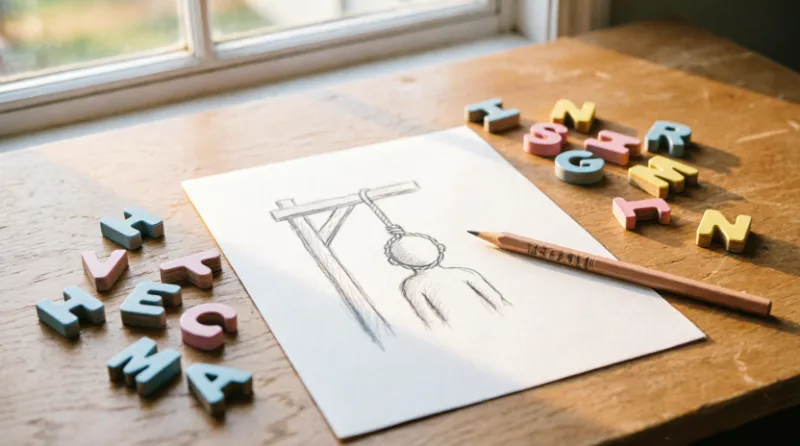
Hangman is a word-guessing game in which one player chooses a secret word or phrase and the other player or players try to reveal it by guessing letters.
Correct letters are added to the blanks, while each incorrect guess moves the game one stage closer to its losing condition.
A standard game needs only two people, paper and a pencil, although Hangman can also be played with teams, classrooms or larger groups. Most versions allow around six to eight incorrect guesses before the round ends.
The basic rules take only a few minutes to learn, but Hangman becomes considerably more strategic when players understand common English letters, word patterns and how the selected category affects likely answers.
What Is Hangman?
Hangman is a traditional guessing game built around vocabulary, spelling and deduction.
The host secretly chooses a word, phrase or sentence and represents each unknown letter with a blank. Guessers then suggest letters.
If a guessed letter appears in the answer, every occurrence is revealed. If it does not appear, the host adds another stage to the drawing or reduces the player’s remaining chances.
| Hangman Feature | Standard Format |
| Players | 2 or more |
| Roles | One host and one or more guessers |
| Materials | Paper and pencil, whiteboard or digital equivalent |
| Objective | Reveal the secret word before running out of guesses |
| Typical wrong guesses | 6–8 |
| Suitable for | Families, classrooms, language learners and game nights |
| Typical round length | A few minutes |
| Skills involved | Vocabulary, spelling, pattern recognition and deduction |
Hangman is particularly flexible because it does not require a commercial game set. Players can change the difficulty, category, number of guesses and even the image used to track mistakes.
What Do You Need to Play Hangman?
A basic game requires very little preparation. Players need somewhere to display the secret-word blanks, somewhere to record guessed letters and a method for counting incorrect guesses.
Paper and a pencil are enough for two players. A whiteboard works well for classrooms or larger groups, while an online document or shared screen can be used when playing remotely.
Before starting, agree on several house rules. Decide whether proper nouns are allowed, whether the host must provide a category, whether phrases can contain spaces or punctuation and what happens if someone guesses the complete word incorrectly.
It is also important to decide exactly how many incorrect guesses are permitted. This prevents disagreements later in the round.
What Are the Hangman Drawing Stages?
There is no single compulsory drawing sequence. Some players draw the gallows before the game and use only the six body parts as incorrect guesses. Others make the gallows itself part of the progression.
An eight-stage version provides a useful balance:
| Wrong Guess | Drawing Stage |
| 1 | Base or upright post |
| 2 | Top beam and rope |
| 3 | Head |
| 4 | Body |
| 5 | Left arm |
| 6 | Right arm |
| 7 | Left leg |
| 8 | Right leg – game lost |
For a shorter six-mistake game, draw the gallows before guessing begins and count only the head, body, two arms and two legs.
Recommended visual for this section: add an eight-panel progression graphic showing Stage 1 through Stage 8 side by side. Label each stage clearly so new players can understand exactly when another part should be drawn.
Extra details such as eyes, a mouth, hands or shoes can also be added if players want a longer and more forgiving game.
What Are the Rules of Hangman?
The central rules stay the same regardless of whether Hangman is played on paper, on a whiteboard or digitally.
| Rule | How It Works |
| Secret answer | The host chooses a word, phrase or sentence without showing the guessers |
| Blanks | One blank is shown for every hidden letter |
| Correct letter | Every occurrence of that letter is revealed |
| Wrong letter | One incorrect-guess stage is recorded |
| Repeated guess | Usually no additional penalty if the mistake is accidental, although house rules can differ |
| Whole-word guess | Usually permitted at any point |
| Wrong whole-word guess | Can count as one mistake if agreed before play |
| Winning | The complete answer is revealed before all chances are used |
| Losing | The final drawing stage is reached before the answer is solved |
Clarifying these rules before the first guess makes competitive or classroom games much easier to manage.
How Do You Play Hangman Step by Step?
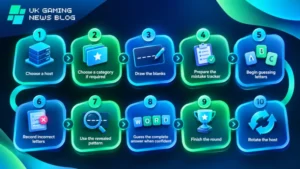
- Choose a host. One player secretly selects the answer. It can be a single word, phrase or sentence depending on the agreed rules.
- Choose a category if required. Categories such as animals, food, films, sport or geography make the game easier and help players make informed guesses.
- Draw the blanks. Add one blank for every letter while keeping spaces between separate words. Punctuation can either be shown immediately or hidden under house rules.
- Prepare the mistake tracker. Draw the starting gallows or another agreed visual and confirm whether six, eight or another number of incorrect guesses will be allowed.
- Begin guessing letters. Players call out one letter at a time. Correct letters are entered everywhere they occur in the answer.
- Record incorrect letters. Add one drawing stage for every letter that is not present and keep visible track of letters already attempted.
- Use the revealed pattern. Guessers should examine word length, known letters, possible prefixes, endings and the category before choosing the next letter.
- Guess the complete answer when confident. A player can normally attempt the whole word or phrase before every letter has been uncovered.
- Finish the round. The guessers win if the answer is solved first. The host wins if all permitted mistakes are used.
- Rotate the host. For multiple rounds, let another player choose the next answer.
How Many People Can Play Hangman?
Hangman works with considerably more than two players.
| Group Size | Recommended Format |
| 2 players | One host and one guesser |
| 3–6 players | One host with guessers taking turns |
| 6+ players | Divide players into teams |
| Classroom | Teacher acts as host while pupils guess individually or by team |
| Large group | Teams alternate guesses with a time limit |
With three or more individual guessers, establish a fixed turn order. A player suggests one letter and play then moves to the next person regardless of whether that guess was correct.
For team Hangman, each team can briefly discuss its choice before submitting one letter. Alternating teams prevents the loudest player from dominating the round.
Players who enjoy social guessing games may also like how to play Pictionary, where the hidden answer is communicated through drawings rather than individual letters.
What Are the Best Letters to Guess First in Hangman?
Random guessing wastes valuable chances. English letters occur at very different frequencies, so some guesses are statistically much safer than others.
Typical English-text frequencies place E, T, A, O, I and N near the top.
| Rank | Letter | Approx. Frequency in English Text | Hangman Use |
| 1 | E | 12.7% | Excellent opening guess |
| 2 | T | 9.1% | Strong common consonant |
| 3 | A | 8.2% | Useful early vowel |
| 4 | O | 7.5% | Strong vowel choice |
| 5 | I | 7.0% | Common in many word structures |
| 6 | N | 6.7% | Very useful consonant |
| 7 | S | 6.3% | Valuable for plurals and endings |
| 8 | H | 6.1% | Useful in common combinations such as TH |
| 9 | R | 6.0% | Appears in many common words |
| 10 | D | 4.3% | Useful once the pattern develops |
The traditional frequency sequence ETAOIN SHRDLU is useful as a reminder, but Hangman should not be played by mechanically guessing every letter in that order.
Ordinary-text frequency and Hangman-word frequency are not exactly the same thing. The word’s length, category and revealed positions can quickly make another letter more valuable.
Should You Guess Vowels First?
Starting with a common vowel is usually sensible because it can reveal the structure of the word quickly.
E is generally an excellent first guess. A or O can also provide useful information.
However, guessing all five vowels before considering consonants is not always optimal. Words such as rhythm show why: A, E, I, O and U can all fail while common consonants would have provided more information.
A stronger approach is to try one or two common vowels, then combine them with high-frequency consonants such as T, N, S and R.
For example, after guessing E, A, T and R, the pattern might already reveal enough information to stop relying on general frequencies and start solving the actual word.
How Can Word Patterns Help You Win Hangman?
Letter frequency is most valuable early in a round. Once several positions are revealed, pattern recognition becomes more important.
| Pattern | What to Consider |
| _ _ I N G | Words ending in ING |
| _ _ E D | Past-tense ED ending |
| _ I O N | Common ION ending |
| _ _ L L | Possible double L |
| _ S _ | S may be part of a plural or consonant cluster |
| T H _ | E, A, I or R may become strong next guesses |
| _ A _ E | Consider common four-letter structures such as game, name or late |
Prefixes such as RE-, UN-, DIS- and PRE- can also narrow the possibilities.
Similarly, recognising endings such as -ING, -ED, -ER, -LY, -TION and -NESS can sometimes reveal several remaining letters at once.
Another useful skill is recognising repeated letters. If a correct guess fills two or three positions simultaneously, the shape of the word may become much easier to identify.
Players wanting another vocabulary-based challenge can compare these deduction skills with the rapid word-building required when learning how to play Bananagrams.
What Are the Hardest Words in Hangman?
Words are usually difficult when they contain rare letters, very few different letters, unusual vowel patterns or letter combinations that players are unlikely to test early.
A 2010 Wolfram Research analysis of Hangman strategy identified jazz as particularly difficult and highlighted words including buzz, hajj, faff, fizz and fuzz among challenging choices.
Consider why jazz is so effective. It contains only four letters, has just three different letters and relies heavily on J and Z, both of which are normally guessed very late.
Other challenging examples include:
| Word | Why It Is Difficult |
| Jazz | J and Z are rare, with Z repeated |
| Buzz | Rare Z plus repeated letter |
| Hajj | Rare J appears twice |
| Fizz | Double Z and few distinct letters |
| Fuzz | Double Z with limited information from vowels |
| Rhythm | No A, E, I, O or U |
| Lynx | Short word containing X and no conventional vowel |
| Fjord | J is uncommon and the consonant pattern is unusual |
Long words are not automatically harder. They often contain several common letters, meaning early guesses can expose much of the answer.
There is no universal “easiest Hangman word” because difficulty changes according to the dictionary, category and number of permitted mistakes.
In general, words containing several high-frequency letters and familiar patterns are easier than short words built from rare letters.
What Hangman Variations Can You Try?
House rules can substantially change the game without making it difficult to learn.
| Variation | How It Works |
| Blind Hangman | No category, definition or contextual clue is provided; players rely entirely on the blanks and revealed letters |
| Team Hangman | Players form teams and discuss one guess before each turn |
| Themed Hangman | Every answer comes from one category such as football, animals, films or geography |
| No-Repeat-Letter Rule | Repeating a previously guessed letter counts as a mistake |
| Phrase Mode | Use film titles, sayings, song titles or complete phrases rather than single words |
| Definition Clue Mode | Give the meaning of the answer before play begins |
| Language-Learning Hangman | Answers come from vocabulary currently being studied |
| Speed Hangman | Players have a fixed number of seconds to make each guess |
| Reduced-Life Mode | Allow only four or five mistakes for experienced players |
| Extended Hangman | Add face, hands or other drawing stages to provide extra chances |
Definition Clue Mode is particularly useful for language learners because players must connect spelling with meaning rather than simply discovering an isolated word.
Team-based players who prefer describing words aloud rather than revealing individual letters can also try Articulate, another group word game built around quick vocabulary recall.
Can Hangman Be Made More Family-Friendly or Classroom-Safe?
The traditional hanging imagery can be uncomfortable or inappropriate in some educational, cultural or family settings.
Fortunately, nothing about the word-guessing mechanic requires that imagery.
The same number of mistakes can instead be represented by an apple tree losing one apple per incorrect guess, a snowman being assembled piece by piece, flower petals disappearing, sections of a rocket being completed or slices being removed from a pie.
For example, an eight-apple tree gives players exactly the same eight chances as an eight-stage traditional Hangman drawing.
Teachers can therefore preserve all of the spelling, vocabulary and deduction elements while choosing visuals that better suit the age and setting of the group.
What Are Good Hangman Words to Use?
The best answers are challenging enough to require deduction without being so obscure that guessing becomes impossible.
Here is a ready-to-use word bank:
| Category | Easy | Medium | Hard |
| Animals | Tiger, Panda, Rabbit | Penguin, Dolphin, Hamster | Lynx, Gazelle, Chimpanzee |
| Food | Bread, Apple, Pizza | Avocado, Pancake, Lasagne | Quiche, Zucchini, Gnocchi |
| Sport | Tennis, Rugby, Cricket | Stadium, Referee, Cycling | Gymnastics, Decathlon, Squash |
| Geography | London, France, River | Iceland, Sahara, Everest | Kyrgyzstan, Mozambique, Archipelago |
| Games | Chess, Bingo, Cards | Pictionary, Monopoly, Scrabble | Bananagrams, Backgammon, Stratego |
| General | House, Water, Garden | Journey, Blanket, Thunder | Rhythm, Zephyr, Jazz |
For children or beginners, use familiar vocabulary and provide a category. Intermediate players can remove the category clue. Experienced players can use uncommon spellings, phrases and difficult letter combinations.
Printable Hangman Practice Sheet
A reusable paper version can be kept extremely simple:
Category: __________________________
Secret word or phrase:
Guessed letters:
A B C D E F G H I J K L M
N O P Q R S T U V W X Y Z
Wrong guesses: ____ / 8
Drawing stages:
1 → 2 → 3 → 4 → 5 → 6 → 7 → 8
For a classroom printable, repeat this layout two or four times on one A4 page so pupils can play several rounds without needing separate sheets.
How Did Hangman Originate?
The precise origin of Hangman is uncertain, but similar word-guessing games have been documented for well over a century.
Alice Bertha Gomme described a related game called Birds, Beasts and Fishes in an 1894 collection of traditional children’s games. The game involved filling missing letters but did not use the hanging figure now associated with Hangman.
A version involving hanging imagery was documented in 1902 in connection with a “White Cap Party”, showing that the recognisable visual form of the game had appeared by the early twentieth century.
Hangman’s influence later spread well beyond pen-and-paper play.
Brazil had a television programme based on the game known as Vamos Brincar de Forca, or “Let’s Play Hangman”.
Its most famous television connection, however, is Wheel of Fortune.
Is Wheel of Fortune Based on Hangman?
Yes. Merv Griffin developed Wheel of Fortune using Hangman as a major inspiration, adding a roulette-style wheel and prize mechanics to turn the word puzzle into a television game show.
The relationship becomes obvious when the core mechanics are compared.
| Hangman | Wheel of Fortune |
| Hidden word or phrase | Hidden word or phrase |
| Players guess letters | Contestants call letters |
| Correct letters are revealed | Correct letters appear on the puzzle board |
| Players can solve before every letter is shown | Contestants can solve before every letter is shown |
| Incorrect letters use up opportunities | Incorrect choices can surrender control |
| No scoring system required | Wheel, cash and prizes create the scoring system |
Wheel of Fortune therefore expands the basic Hangman concept rather than copying its complete rules.
The connection also helps explain why a simple nineteenth-century-style word puzzle remains culturally recognisable today.
Is Hangman Good for Children and Language Learners?

Hangman can be useful for practising vocabulary, spelling and pattern recognition when the words match the player’s ability.
For younger children, familiar categories such as animals, food and household objects help reinforce spelling without making rounds frustrating.
For English-language learners, a definition-based version is particularly effective. The host provides a meaning or context clue and the learner must combine that clue with the revealed letters.
Hangman can also encourage players to notice common prefixes, suffixes, repeated letters and spelling structures rather than memorising words in isolation.
It should not replace structured language teaching, but it can provide an engaging way to practise vocabulary already being learned.
What Common Hangman Mistakes Should You Avoid?
One frequent mistake is continuing to guess letters purely according to frequency after enough information has already been revealed. Letter statistics are an opening strategy, not a substitute for analysing the word.
Another is using every vowel immediately. A couple of vowels can expose the word’s structure, but five unsuccessful vowel guesses can quickly exhaust a short game.
Players should also keep a visible record of attempted letters. Repeating a guess provides no new information and can even cost a life under stricter house rules.
Hosts can create problems too. Extremely obscure technical words, unexplained foreign words or unexpected proper nouns often turn deduction into blind luck. The answer should match the difficulty level agreed before the round starts.
FAQs About How to Play Hangman
How many guesses do you get in Hangman?
There is no universal number. Six incorrect guesses are common when the gallows is already drawn and the head, body, two arms and two legs are counted. Other versions allow eight or more stages. Players should agree on the limit before the game begins.
Can you guess the whole word early in Hangman?
Yes. Most versions allow the guesser to solve the complete word or phrase at any point. Players should decide beforehand whether an incorrect full-word attempt counts as one wrong guess.
What is the best first letter to guess in Hangman?
E is usually one of the strongest opening guesses because it is the most frequent letter in general English text. T, A, O, I, N, S and R are also useful early choices, although the best guess changes once the category and word pattern provide more information.
Should you guess vowels first in Hangman?
Starting with one or two common vowels can reveal the structure of a word, but guessing every vowel first is not always the best strategy. Combining vowels with common consonants such as T, N, S and R normally provides more balanced information.
What is the hardest Hangman word?
There is no absolute answer for every rule set, but a 2010 Wolfram Research analysis found jazz particularly difficult. Words such as buzz, hajj, fizz and fuzz are also challenging because they contain uncommon letters and relatively few distinct characters.
Is Hangman suitable for children?
Yes, particularly when familiar words and suitable difficulty levels are used. Schools and families that prefer not to use hanging imagery can replace the traditional drawing with an apple tree, snowman, flower, rocket or another progress tracker.
Can three or more people play Hangman?
Yes. One player can act as the host while the remaining players take turns guessing. Larger groups can be divided into teams, with each team submitting one letter per turn.
Is Hangman useful for ESL or language learners?
It can be a useful vocabulary and spelling activity. Definition clues, themed vocabulary and target-language words can make the game particularly useful for practising material learners have already studied.