
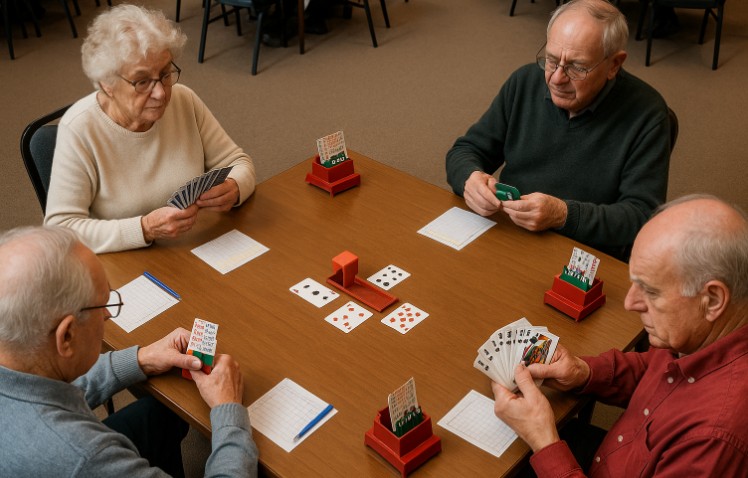
Bridge is a four-player partnership card game in which two pairs compete to win tricks. Each player receives 13 cards, an auction determines the contract, one partnership tries to make that contract, and the other pair attempts to defeat it.
The part that makes bridge look difficult to beginners is usually the bidding rather than the card play. Once the basic idea is understood, however, a first hand can be played surprisingly quickly.
A beginner only needs to remember four things at the start: partners sit opposite each other, players must follow suit when possible, the auction determines how many tricks the declaring partnership promises to take, and every contract starts from a base of six tricks.
For example, 4♠ does not mean four tricks. It means six plus four, so the declaring side needs 10 tricks with spades as trumps.
This introduction explains how to play bridge from the first deal through bidding and scoring, including a complete example hand, beginner bidding charts, UK Acol conventions, duplicate and rubber scoring, common irregularities and the bridge terminology new players are most likely to encounter.
What Is the Bridge Card Game?
Contract bridge is a trick-taking game played by four people with a normal 52-card deck and no jokers.
The players are normally identified by compass positions:
| Position | Partnership |
| North | North-South |
| East | East-West |
| South | North-South |
| West | East-West |
North sits opposite South, while East sits opposite West.
Every player receives 13 cards. The cards rank from Ace high through King, Queen, Jack, 10 and down to 2.
A complete deal contains an auction followed by the play of 13 tricks. Each trick contains four cards, one from each player.
Bridge developed from earlier trick-taking games such as whist, but contract bridge adds an auction in which players describe their hands and compete to determine the final contract.
Your First Bridge Game in 10 Minutes
A beginner does not have to memorise an entire bidding system before playing.
One practical introduction is Minibridge, which uses bridge’s normal cards, tricks, partnerships, dummy and contracts but temporarily removes the auction.
In Minibridge, players count their High Card Points first:
| Honour | High Card Points |
| Ace | 4 |
| King | 3 |
| Queen | 2 |
| Jack | 1 |
There are exactly 40 HCP in the deck.
Players announce their totals. The partnership with more combined points becomes the declaring side. Its stronger hand normally becomes declarer while the other hand is placed face-up as dummy.
The declarer then chooses a trump suit or no trumps and decides whether to attempt a part-score or game.
This allows a new player to learn tricks, following suit, trumping, declarer play and dummy before having to understand the bidding language.
Once that feels comfortable, normal bridge simply adds the auction before the play.
How Do You Play Bridge Step by Step?
A complete bridge deal can be reduced to four stages:
- Deal: Shuffle a standard 52-card deck and give every player 13 cards.
- Auction: Starting with the dealer, players bid, pass, double or redouble until the contract is established.
- Play: The player to declarer’s left makes the opening lead, dummy is exposed and all 13 tricks are played.
- Score: The declaring side scores for making its contract, or the defenders score penalties when the contract fails.
The dealer changes clockwise for subsequent deals.
Following Suit and Winning a Trick
The player who leads a trick may choose any card in their hand.
The other three players must follow the suit led whenever they can.
Suppose West leads the ♥10. If North has a heart, North must play a heart. North cannot discard a club or play a spade trump simply because it would be more convenient.
If nobody plays a trump, the highest card of the suit led wins.
If a player cannot follow suit and the contract has a trump suit, that player may play a trump. A trump beats any card from a non-trump suit.
The winner of the trick leads to the next trick.
Declarer and Dummy
When the auction finishes, one player becomes declarer.
Declarer is the first player from the partnership that won the auction who bid the denomination of the final contract.
The opponent to declarer’s left makes the opening lead. Only after that lead is made does declarer’s partner expose all 13 cards face-up on the table.
That exposed hand is the dummy.
Dummy does not choose which cards to play. Declarer controls both their own cards and dummy’s cards for the remainder of the deal.
How Does Bidding Work in Bridge?
The auction is the feature that separates bridge from simpler trick-taking games.
A bid contains a level from 1 to 7 and one of five denominations:
Clubs < Diamonds < Hearts < Spades < No Trump
The complete bidding ladder therefore begins:
| Lower Bid | Next Higher Bid |
| 1♣ | 1♦ |
| 1♦ | 1♥ |
| 1♥ | 1♠ |
| 1♠ | 1NT |
| 1NT | 2♣ |
| 2♣ | 2♦ |
The same pattern continues all the way to 7NT.
Every new bid must rank above the previous bid.
If one player bids 1♠, another cannot bid 1♥ because hearts rank below spades at the same level. They could bid 1NT, 2♣, 2♦ or anything higher.
What Do Bridge Bids Actually Mean?
The level indicates the number of tricks promised above six.
| Contract | Tricks Required |
| 1♣ | 7 |
| 2♥ | 8 |
| 3NT | 9 |
| 4♠ | 10 |
| 5♦ | 11 |
| 6♥ | 12 |
| 7NT | 13 |
A contract of 6♠ is called a small slam because declarer must take 12 tricks.
A contract at the seven level is a grand slam, requiring all 13 tricks.
Pass, Double and Redouble
Passing means declining to make a bid at that turn. A player who passes may still bid later if the auction continues.
A double can be made against an opponent’s contract when the appropriate conditions are met. It increases both the reward for defeating the contract and the value of making it.
A redouble may follow an opponent’s double and raises the stakes again.
After a bid has been followed by three consecutive passes, the auction ends.
If all four players pass without anyone bidding, the deal is passed out.
What Are Part-Scores, Games and Slams?
Not every successful contract is worth the same amount.
A part-score is a contract whose trick value is below the 100 points needed for game.
The normal contracts that reach game in one deal are:
| Game Contract | Required Tricks | Contract Trick Score |
| 3NT | 9 | 100 |
| 4♥ | 10 | 120 |
| 4♠ | 10 | 120 |
| 5♣ | 11 | 100 |
| 5♦ | 11 | 100 |
This explains why players usually prefer 3NT or four of a major to five of a minor when more than one contract is realistic.
A rough combined-point guide is:
| Partnership Strength | Typical Ambition |
| Below about 25–26 HCP | Usually part-score unless shape adds significant value |
| About 26 HCP | Often enough to investigate game |
| About 33 HCP | Small slam becomes realistic |
| About 37 HCP | Grand slam becomes realistic |
These figures are guides, not guarantees. Distribution, suit fit, controls, intermediates and bidding system can make a hand worth considerably more or less than its raw HCP total.
How Do You Evaluate a Bridge Hand?
Beginners usually begin with High Card Points:
Ace = 4, King = 3, Queen = 2 and Jack = 1.
That gives a quick estimate of honour strength, but HCP alone does not tell the full story.
When Should Distribution Points Be Added?
A common beginner mistake is adding points for every singleton, doubleton and void before knowing whether those shortages are useful.
Shortness becomes particularly valuable after a trump fit has been found.
If partner and you have enough cards in one suit to use it as trumps, a singleton or void may allow one hand to ruff losing cards from the other.
A simple support-point approach sometimes values shortages approximately as:
| Shortage | Typical Extra Value After Finding a Fit |
| Void | 3 or more points |
| Singleton | About 2 points |
| Doubleton | About 1 point |
Different teaching systems use different scales, and experienced players evaluate distribution more dynamically.
The important beginner rule is: do not automatically add shortage points to every hand before a fit exists.
What Is the Rule of 20?
The Rule of 20 is sometimes used when deciding whether a distributional hand that is slightly below normal opening strength is worth opening.
Add your HCP to the number of cards in your two longest suits.
For example, an 11-HCP hand with five spades and four hearts gives:
11 + 5 + 4 = 20
That may justify an opening bid if the honour placement and suit quality are suitable.
It is a judgement tool rather than a rule requiring every 20-counting hand to be opened.
Bridge Opening Bids and Responses Cheat Sheet
No single chart can cover every bidding system, but the following provides a useful beginner framework.
| Situation | Approximate Strength | Typical Action |
| Very weak hand | 0–5 HCP | Usually pass unless a specific convention applies |
| Normal opening hand | Around 12+ HCP | Usually open one of a suit or the appropriate NT bid |
| Light distributional opening | Around 10–11 HCP | Rule of 20 may support opening |
| Responder minimum | 6–9 HCP | Make a minimum response when appropriate |
| Invitational responder | 10–12 HCP | Invite opener towards game |
| Strong responder | 13+ HCP | Usually ensure the auction reaches game if opener has a normal opening hand |
| Weak two | Usually a six-card suit and limited strength | Pre-emptive opening; exact range depends on system |
| Game-going partnership | Roughly 26 combined points | Explore the appropriate game |
| Small slam territory | Roughly 33 combined points | Investigate slam if controls and shape cooperate |
| Grand slam territory | Roughly 37 combined points | Grand slam may be possible |
These ranges need to be interpreted within the partnership’s chosen system.
Acol vs Standard American: What Should UK Players Know?
British beginners are particularly likely to encounter Acol, while many online lessons and international players use a form of Standard American.
The systems are related but not interchangeable.
| Feature | Acol-Style Approach | Standard American-Style Approach |
| 1NT opening | Commonly 12–14 HCP | Commonly 15–17 HCP |
| Major-suit opening | Four-card majors are traditionally possible | Usually promises at least five cards |
| One-level suit opening | Natural | Natural |
| Weak two bids | Common in many modern Acol methods | Common |
| Usage | Particularly familiar in Britain | Common internationally and in North America |
Acol itself has many partnership variations, so players should agree their exact 1NT range, two-level openings and conventions before starting.
A beginner does not need dozens of conventions. A natural system with a clearly agreed NT range, Stayman and transfers is enough to start developing partnership understanding.
What Are Stayman, Blackwood and Jacoby Transfers?
Stayman
After partner opens 1NT, a conventional 2♣ response can be used to ask whether opener has a four-card major.
The purpose is often to find a 4-4 heart or spade fit rather than automatically playing in no trumps.
Jacoby Transfers
Jacoby Transfers are frequently misunderstood.
After a 1NT opening, responder can bid the suit immediately below a five-card-or-longer major:
| Responder Bids | Shows |
| 2♦ | Five or more hearts |
| 2♥ | Five or more spades |
Opener then completes the transfer by bidding the requested major.
The important point is that the 1NT opener becomes declarer.
That is useful because the stronger no-trump hand remains hidden while the weaker responder’s cards become dummy. It can protect combinations such as K-J or A-Q from the opening lead.
Jacoby Transfers therefore do not make the weaker hand declarer.
Blackwood
Blackwood is a slam-investigation convention used to discover whether the partnership has enough key high cards before committing to a slam.
Beginners should first become comfortable with natural bidding, game contracts and partnership fits before trying to memorise several layers of slam conventions.
Worked Bridge Deal: Auction, Lead and Play
A complete example makes the structure much easier to understand.
Assume South is the dealer.
The Four Hands
| North | East | South | West |
| ♠ J 10 7 6 | ♠ 3 2 | ♠ A K Q 9 4 | ♠ 8 5 |
| ♥ K 5 2 | ♥ 9 6 | ♥ A 7 3 | ♥ Q J 10 8 4 |
| ♦ A 6 3 | ♦ Q 9 7 | ♦ K 8 4 | ♦ J 10 5 2 |
| ♣ Q 7 6 | ♣ A K J 10 3 2 | ♣ 8 5 | ♣ 9 4 |
South has 16 HCP and five strong spades.
North has 10 HCP and four-card spade support.
Together North-South have 26 HCP and a nine-card spade fit, making a major-suit game a sensible target.
Example Auction
| South | West | North | East |
| 1♠ | Pass | 3♠ | Pass |
| 4♠ | Pass | Pass | Pass |
In a system where 3♠ is being used as an invitational raise, North shows useful strength and good spade support.
South accepts the invitation and bids game.
The final contract is 4♠ by South.
South must therefore win at least 10 tricks.
Opening Lead
West leads the ♥Q.
North now places all 13 cards face-up as dummy.
South can see both South’s hand and North’s hand and should make a plan before playing quickly.
There are nine combined spades, including the A-K-Q-J-10. The defenders’ four missing spades happen to divide 2-2, so trumps can be drawn safely.
South also has the ♥A opposite the ♥K and the ♦K opposite the ♦A.
The main immediate losers are in clubs and potentially diamonds.
Declarer can win the heart lead, draw the opposing trumps, cash the established winners and manage the remaining suits. With competent play, North-South can reach the 10 tricks required for 4♠.
This hand illustrates the whole game in miniature: evaluate strength, find a fit, bid the contract, receive an opening lead, expose dummy, count likely winners and losers, then execute the plan.
How Does Bridge Scoring Work?
One reason bridge scoring appears confusing is that people sometimes mix rules from duplicate bridge, rubber bridge and Chicago.
The card play and contract values are closely related, but the formats do not award every bonus in the same way.
Basic Contract Trick Values
Only tricks above the first six count as contract tricks.
| Denomination | Undoubled | Doubled | Redoubled |
| Clubs | 20 per contract trick | 40 | 80 |
| Diamonds | 20 per contract trick | 40 | 80 |
| Hearts | 30 per contract trick | 60 | 120 |
| Spades | 30 per contract trick | 60 | 120 |
| No Trump, first trick above six | 40 | 80 | 160 |
| No Trump, later contract tricks | 30 | 60 | 120 |
For example, 4♥ made exactly has a contract trick value of 120 because four heart tricks above six are worth 30 each.
Rubber vs Duplicate vs Chicago Bridge
| Feature | Duplicate Bridge | Rubber Bridge | Chicago/Four-Deal Bridge |
| Basic card play | Standard bridge | Standard bridge | Standard bridge |
| Length | Boards/session | Until one side wins two games | Four played deals |
| Game requirement | Contract worth at least 100 trick points on that board | 100 below-the-line trick points, potentially accumulated | 100 trick points; part-scores can contribute within the four-deal set |
| Part-score bonus | 50 | No duplicate-style 50 bonus | Traditional Chicago gives 100 for an unfinished part-score on the fourth deal |
| Game bonus | 300 not vulnerable; 500 vulnerable | Replaced by game/rubber structure | 300 not vulnerable; 500 vulnerable when game is completed |
| Rubber bonus | None | 700 for winning 2-0 or 500 for winning 2-1 | None |
| Honours | Not normally scored | 100 or 150 in qualifying cases | Traditional rules can include honours |
| Vulnerability | Predetermined by board | Acquired after winning a game | Predetermined by deal number |
In traditional Chicago, deal one has neither side vulnerable, deals two and three have one side vulnerable, and deal four has both sides vulnerable. Some groups use an agreed variation for which partnership is vulnerable on deals two and three, so this should be confirmed before starting.
Duplicate Bridge Scoring Chart
Duplicate scoring is the system many club and tournament players encounter most often.
Bonuses for a Made Contract
| Result | Not Vulnerable | Vulnerable |
| Part-score | 50 | 50 |
| Game | 300 | 500 |
| Small slam | 500 | 750 |
| Grand slam | 1,000 | 1,500 |
| Making a doubled contract | +50 | +50 |
| Making a redoubled contract | +100 | +100 |
Slam bonuses are additional to the applicable game bonus.
Overtricks
| Contract | Not Vulnerable | Vulnerable |
| Undoubled | Normal trick value | Normal trick value |
| Doubled | 100 per overtrick | 200 per overtrick |
| Redoubled | 200 per overtrick | 400 per overtrick |
Undertricks
If declarer fails to make the contract, the defenders receive penalty points.
| Number Down | Undoubled NV | Doubled NV | Redoubled NV | Undoubled Vulnerable | Doubled Vulnerable | Redoubled Vulnerable |
| 1 | 50 | 100 | 200 | 100 | 200 | 400 |
| 2 | 100 | 300 | 600 | 200 | 500 | 1,000 |
| 3 | 150 | 500 | 1,000 | 300 | 800 | 1,600 |
| 4 | 200 | 800 | 1,600 | 400 | 1,100 | 2,200 |
After the third undertrick, a doubled non-vulnerable contract costs another 300 for each additional undertrick. A doubled vulnerable contract also costs another 300 for each additional undertrick. Redoubled penalties are twice the corresponding doubled penalties.
This is why vulnerability becomes strategically important. A sacrifice that is attractive when not vulnerable can become very expensive when vulnerable.
How Is Rubber Bridge Scored?
Rubber bridge uses the traditional above-the-line and below-the-line score sheet.
Contract trick points are entered below the line. The first partnership to accumulate at least 100 below-the-line points wins a game.
After a game is won, both sides begin again at zero below the line towards the next game.
The first side to win two games wins the rubber.
The rubber winner receives:
| Rubber Result | Bonus |
| Win two games while opponents win none | 700 |
| Win two games while opponents win one | 500 |
Rubber bridge can also award honours.
Holding four of the five top trump honours—A, K, Q, J and 10—in one hand scores 100. Holding all five in one hand scores 150. At no trumps, holding all four aces in one hand scores 150.
Many social groups agree not to count honours because they reward the deal rather than a player’s decisions, so the scoring method should be agreed before the rubber begins.
How Should Declarer Play a Bridge Hand?
Good declarer play begins before playing from dummy to the first trick.
Start by counting obvious winners in no trumps or potential losers in a suit contract.
Then decide where additional tricks might come from.
Important techniques include:
| Technique | What It Means |
| Draw trumps | Remove opponents’ trumps before they can ruff your winners |
| Establish a suit | Force out opponents’ high cards so lower cards become winners |
| Finesse | Play towards an honour while hoping a particular opposing honour is favourably placed |
| Ruff | Use a trump when unable to follow the suit led |
| Crossruff | Win tricks by alternating ruffs between declarer and dummy |
| Hold-up | Deliberately delay taking a winner to break opponents’ communication |
| Preserve entries | Keep cards that allow you to move between declarer’s hand and dummy |
A common beginner mistake is automatically drawing every trump. Sometimes declarer needs dummy’s trumps to ruff losers first.
The better habit is to ask: What can defeat this contract, and what order should the suits be played in?
How Do You Defend in Bridge?
The defenders have a different challenge because they cannot see each other’s cards.
After dummy appears, each defender can see three important sources of information: their own hand, the dummy and the auction.
That is often enough to infer much of the missing distribution.
Typical defensive concepts include leading from sequences, establishing long suits against no trumps, returning partner’s suit when appropriate and using agreed signals.
A traditional opening lead against no trumps is often the fourth-highest card from a useful long suit, while a sequence such as K-Q-J may suggest leading the top honour.
These are guidelines rather than commands. The auction and visible dummy should always influence the plan.
What Advanced Bridge Strategies Come Next?

Once bidding, scoring and basic card play are comfortable, players can start studying more sophisticated techniques.
A squeeze forces an opponent to discard protection from one of two important suits.
An endplay deliberately gives an opponent the lead when every legal return benefits declarer.
Counting the hand means using the auction and cards already played to reconstruct opponents’ likely distributions.
Players can also study the Losing Trick Count, suit combinations, safety plays, defensive signals, competitive bidding and the Law of Total Tricks.
These concepts are useful, but they should come after the fundamentals. A player who consistently counts trumps, follows the auction and plans at trick one will normally improve faster than somebody who memorises advanced conventions without mastering basic play.
Bridge Etiquette and Communication Rules
Bridge partnerships may communicate through their legal calls and card plays, but not through facial expressions, gestures, unusual tone, comments or deliberate changes of tempo.
A hesitation can happen naturally. The important point is that partner must not use unauthorised information conveyed by that hesitation.
Players should also explain agreed conventions when required under the rules of the event.
Criticising partner during the hand is poor etiquette and rarely improves anyone’s play. Discussion is better saved until the deal has finished.
Tournament bridge also uses procedures for alerts, bidding boxes, explanations and director calls. New players should not be embarrassed if the tournament director is called. The director’s role is to apply the rules and restore an equitable result, not automatically to accuse someone of wrongdoing.
What Happens If Someone Revokes or Plays Out of Turn?
Bridge has formal procedures for irregularities.
A revoke means failing to follow suit despite holding a card of the suit led.
If the error is discovered before the revoke becomes established, it can often be corrected subject to the applicable rules.
Once established, an adjustment may apply. In duplicate bridge, this can involve transferring one or, in some circumstances, two tricks to the non-offending side. The exact ruling depends on who won the revoke trick, what happened afterwards and whether an exception applies.
The safest tournament procedure is therefore simple: stop play and call the director rather than trying to invent a penalty at the table.
A lead out of turn also has specific remedies and may sometimes be accepted by an opponent. Again, players should not move cards around or decide the ruling themselves in organised competition.
An accidentally exposed defender’s card may become a penalty card.
When claiming the remaining tricks, a player should state clearly how the rest of the hand will be played. If there is disagreement, play should stop and the appropriate ruling procedure should be followed.
Common Bridge Terms for Beginners
| Term | Meaning |
| Auction | The bidding phase that determines the contract |
| Bid | A level plus a denomination, such as 2♥ or 3NT |
| Contract | The final commitment to take a specified number of tricks |
| Declarer | Player who plays the contract and controls dummy |
| Dummy | Declarer’s partner’s face-up hand |
| Defender | Either member of the opposing partnership |
| Trick | One card played by each of the four players |
| Trump | A suit whose cards outrank cards in the other suits when legally played |
| No Trump | A contract with no trump suit |
| Ruff | Playing a trump when unable to follow the suit led |
| Revoke | Failing to follow suit despite being able to do so |
| Overtrick | A trick made above the contracted target |
| Undertrick | A trick by which declarer falls short of the contract |
| Part-score | A contract worth less than 100 contract trick points |
| Game | A contract worth at least 100 contract trick points |
| Small Slam | Contract for 12 tricks |
| Grand Slam | Contract for all 13 tricks |
| Vulnerable | Scoring status that increases certain rewards and penalties |
| Fit | Sufficient combined length in a suit, normally eight or more cards |
| HCP | High Card Points |
| Finesse | Technique for attempting to win a trick despite a missing higher honour |
| Claim | A statement that a player expects to win a specified number of remaining tricks |
Should You Learn Bridge, Whist, Spades or Hearts?
The best starting game depends on what you want from card play.
| Game | Players | Partnership Play | Bidding | Complexity | Best For |
| Bridge | 4 | Yes | Extensive | High | Deep partnership strategy |
| Whist | 4 | Yes | Usually no contract auction | Low–medium | Learning traditional trick-taking |
| Spades | Usually 4 | Usually yes | Simple | Medium | Accessible partnership bidding |
| Hearts | Usually 4 | No | No | Medium | Individual trick avoidance |
| Briscola | 2–6 | Depends on format | No bridge-style auction | Medium | Tactical trump-based trick-taking |
Someone who enjoys the trick-taking side of bridge but wants a game with much less bidding may also enjoy Briscola, where trump management and reading the play remain important but the structure is much quicker to learn.
Bridge has the steepest initial learning curve of these games because players must learn both card play and an auction language. It also offers considerably more partnership depth once those foundations are understood.
Where Can You Learn and Play Bridge in the UK?
Beginners in England can look for English Bridge Union-affiliated clubs, beginner courses and recognised bridge teachers.
A local course has an important advantage over learning conventions alone: it teaches bidding together with actual card play, table procedure and partnership discipline.
Online options include Bridge Base Online, Funbridge and RealBridge. These can be useful for practising deals, playing with robots, joining organised games or playing remotely with a regular partner.
Apps can also help with hand evaluation, bidding practice and declarer-play exercises.
A sensible learning progression is Minibridge first, then natural bidding, an agreed Acol or other system, basic competitive bidding and only then more elaborate conventions.
Quick Bridge Cheat Sheet
| Question | Quick Answer |
| How many players? | Four |
| How many partnerships? | Two |
| Cards per player | 13 |
| Highest card | Ace |
| Lowest card | 2 |
| Bid order | ♣ < ♦ < ♥ < ♠ < NT |
| Minimum contract | 1-level = 7 tricks |
| 3NT target | 9 tricks |
| 4♥ or 4♠ target | 10 tricks |
| 5♣ or 5♦ target | 11 tricks |
| Small slam | 12 tricks |
| Grand slam | 13 tricks |
| HCP values | A=4, K=3, Q=2, J=1 |
| Rough game strength | About 26 combined HCP |
| Rough small-slam strength | About 33 combined HCP |
| Rough grand-slam strength | About 37 combined HCP |
This table can also be converted into a one-page printable bridge cheat sheet for readers who want to keep the bidding hierarchy, trick targets and point values beside them during their first games.
FAQs
Is Bridge Hard to Learn?
Bridge is more complex than many traditional card games because players must learn both trick-taking and bidding. The core play rules, however, are fairly straightforward. Starting with Minibridge and adding the auction afterwards can make the learning process considerably easier.
How Many People Play Bridge?
Standard contract bridge requires four players divided into two partnerships. North partners South, while East partners West.
Can Bridge Be Played With Two Players?
Standard contract bridge cannot be played properly with two players because its structure requires four hands and two partnerships. There are bridge-inspired adaptations for fewer players, but they are not normal four-player contract bridge.
Can Bridge Be Played With Three Players?
Not in its standard form. Three-player adaptations exist, but standard duplicate and rubber bridge require four players.
How Many Points Do You Need to Open in Bridge?
A normal one-level opening often starts at around 12 HCP, although distribution and the chosen bidding system matter. The Rule of 20 can justify opening some distributional hands with fewer raw HCP.
How Many Points Do You Need for Game in Bridge?
About 26 combined HCP is a useful beginner guideline. The actual requirement can be lower or higher depending on distribution, fit and where the partnership’s honours are located.
What Is the Highest Bid in Bridge?
7NT is the highest possible contract. It commits declarer to winning all 13 tricks without a trump suit.
What Does 3NT Mean?
3NT means the partnership contracts to win nine tricks because every level represents that number plus the first six tricks. No suit is designated as trump.
What Is the Dummy in Bridge?
Dummy is declarer’s partner. After the opening lead, dummy places all 13 cards face-up and declarer chooses which card is played from dummy whenever it is dummy’s turn.