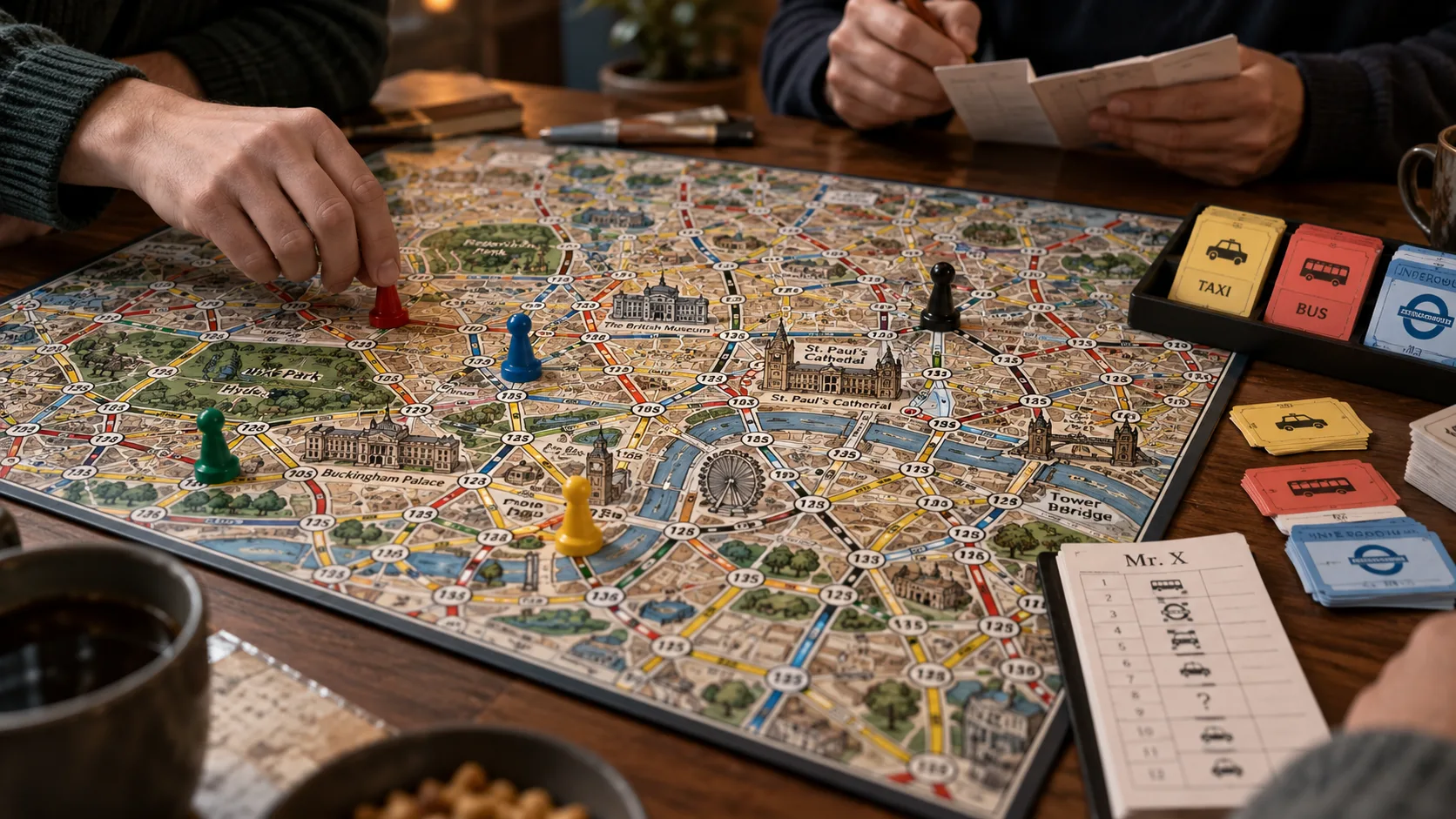
The Scotland Yard board game is a classic detective strategy game in which one player becomes the mysterious Mr X while the others cooperate to track him down across London.
Players travel between numbered stations using taxi, bus and Underground tickets, with Mr X recording his movements secretly and revealing his location at designated moments.
First released in 1983, the game remains a popular choice for families, board-game enthusiasts and players who enjoy deduction challenges.
However, different editions have different rules, ticket allocations and player requirements. The original 1985 version is not identical to the modern Ravensburger editions.
This updated guide explains the rules step by step, covers the official two-player setup, compares editions, and examines the strengths and limitations of this classic pursuit game.
What Is the Scotland Yard Board Game?
Scotland Yard is an asymmetric, hidden-movement board game published by Ravensburger. It takes place on a map of central London, where players use transport connections to move between numbered stations.
One player controls Mr X, a fugitive whose movements are mostly hidden. The other players act as detectives, working together to discover his location and prevent his escape.
Unlike a conventional competitive board game, the two sides have different information and responsibilities.
Mr X has secrecy, special travel tickets and the ability to make double moves. Detectives have numerical superiority, shared information and opportunities to restrict escape routes.
The modern standard game has the following specifications:
| Feature | Standard Ravensburger edition |
| Publisher | Ravensburger |
| Original release | 1983 |
| Current edition | 2025 edition, product 27514 |
| Players | 2–6 |
| Recommended age | 8+ |
| Typical playing time | Approximately 45 minutes |
| Genre | Hidden movement, deduction, cooperative strategy |
| Setting | Central London |
| Main objective | Capture Mr X or escape the detectives |
| 1983 award | Spiel des Jahres |
The 2025 edition includes a beginner-friendly rules option, making the game accessible to players unfamiliar with hidden-movement mechanics.
For families exploring similar tabletop entertainment, Scotland Yard is worth considering alongside other popular board games involving teamwork, tactics and competitive decision-making.
Who Created Scotland Yard?
Scotland Yard was developed by a six-person Ravensburger project team:
- Werner Schlegel
- Dorothy Garrels
- Fritz Ifland
- Manfred Burggraf
- Werner Scheerer
- Wolf Hörmann
The development team reportedly drew inspiration from traditional pursuit games involving police officers and criminals.
An early prototype was called Manhattan, before the game adopted its London setting.
Scotland Yard won the prestigious Spiel des Jahres award in 1983, the year of its original publication.
The official award history records the production of the game’s millionth copy in March 1985. Historical accounts also report that more than four million copies had been sold by 2003, although that later total should be treated as a historical reported figure rather than a current sales count.
The game’s longevity comes from a relatively simple but effective idea: one player knows where the fugitive is, while everyone else must reconstruct that information from clues.
What Comes Inside the Scotland Yard Board Game Box?
The components differ between editions. The current Ravensburger standard edition, product number 27514, lists the following equipment:
| Component | Current standard edition |
| London game board | 1 |
| Playing pieces | 6 main figures; additional character pieces may vary by presentation |
| Starting-position cards | 29 |
| Travel tickets | 130 |
| Double-move tickets | 3 |
| Ticket boards | Player boards supplied for the detective roles |
| Mr X travel log | 1 |
| Mr X visor | 1 |
| Bobby identification rings | 2 |
| Instructions | Standard and beginner guidance |
Important: Ravensburger’s product description and equipment specification use different component-count conventions for the playing pieces and ticket boards.
Buyers should consult the exact box inventory rather than assume that every edition contains an identical number of components.
The game board contains numbered stations connected by transport routes. The visor helps Mr X keep his information concealed, while the travel log records his secret destinations.
The two rings identify neutral detective pieces called bobbies, which play an important role when fewer people participate.
How Do You Set Up Scotland Yard?
The setup depends on the edition, but the basic process is straightforward.
Step 1: Prepare the Board
Place the London map in the centre of the table where every participant can read the station numbers and transport routes.
Mr X should sit somewhere they can examine the entire board without revealing their secret notes.
Step 2: Assign the Roles
Choose one player to control Mr X.
The remaining players become detectives.
For a first game, giving the Mr X role to someone familiar with the rules can help because that player must record movements correctly and manage concealed information.
Step 3: Determine Starting Stations
Shuffle the starting-position cards according to the rulebook.
In the modern editions, detective and Mr X starting cards are separated into designated groups.
Detectives draw their cards and place their pieces on the corresponding stations.
Mr X checks the assigned starting position privately and does not normally reveal it.
Step 4: Distribute the Transport Tickets
Give each detective the appropriate allocation of taxi, bus and Underground tickets.
Mr X receives the prescribed black tickets and double-move tickets, along with access to the general supply of ordinary transport tickets under the modern rules.
Step 5: Add Bobbies Where Required
The number of bobbies depends on the number of players. They are identified using the supplied rings and normally move without spending transport tickets.
Step 6: Prepare Mr X’s Travel Log
Mr X takes the log, paper insert and visor.
The player should have a pencil ready to record the destination of every move secretly.
Once these preparations are complete, Mr X begins the chase.
How Many Tickets Does Each Detective Start With?
Ticket allocations are one of the most important differences between older and newer Scotland Yard editions.
| Ticket type | Milton Bradley 1985 | Ravensburger 2013 standard setup | Ravensburger 2025 standard setup |
| Taxi | 10 | 11 | 11 |
| Bus | 8 | 8 | 8 |
| Underground | 4 | 4 | 4 |
| Total per detective | 22 | 23 | 23 |
The 1985 version used 10 taxi tickets per detective, while the modern rules allocate 11.
The 2013 rules also contain a special exception for the two-player setup: the single detective player controls two detective pieces and receives a combined pool of 20 taxi, 16 bus and 8 Underground tickets.
This should not automatically be applied to the 2025 edition, where the published standard detective allocation is 11 taxi, 8 bus and 4 Underground tickets per detective character. Follow the ticket-sharing instructions supplied with the particular edition.
Why Does Ticket Management Matter?
Each detective has limited transport resources.
For example, a detective with no Underground tickets cannot use the Underground even when standing at an Underground station.
Similarly, a player with only Underground tickets remaining could become stranded at a station without an Underground connection.
Detectives should therefore avoid using their fastest transport options unnecessarily during the early rounds.
How Do You Play Scotland Yard Step by Step?
A standard round consists of Mr X moving first, followed by the detective team.
Step 1: Mr X Makes a Secret Move
Mr X selects a legally connected destination using an available form of transport.
The player writes the destination station number in the next space of the travel log and covers it with the ticket used.
The detectives can see the ticket but not the hidden station number.
For example, if Mr X uses a bus ticket, the detectives know he has travelled along a bus connection.
Step 2: The Detectives Examine the Clue
The detectives discuss where Mr X could have travelled.
They use the visible ticket, previously revealed positions, transport routes and occupied stations to identify possible locations.
Step 3: Each Detective Moves
Each active detective moves along one legal transport connection and spends the corresponding ticket.
The detectives may coordinate their movement order.
For example, one detective might occupy an important Underground junction while another approaches a possible escape route.
Step 4: Bobbies Move
Where bobbies are included, the detective team moves them according to the edition’s rules.
Bobbies do not need transport tickets.
Step 5: Check for Capture
If a detective or bobby reaches Mr X’s actual station, the detectives win immediately.
Mr X must also surrender if no legal destination remains available.
Otherwise, the next round begins.
What Are the Main Movement Rules?
Understanding the movement restrictions is essential because mistakes can change the outcome of a game.
| Rule | How it works |
| Legal connection | Move only along a marked route available at the starting station |
| Taxi movement | Follow a yellow taxi line to the next connected taxi station |
| Bus movement | Follow a bus connection to the next bus stop on that route |
| Underground movement | Follow an Underground connection to the next Underground station |
| No skipping transport stops | A player cannot arbitrarily travel beyond the next stop for the transport mode chosen |
| Mandatory movement | A piece with an available legal move must move |
| Occupied stations | Pieces cannot normally end a move on another occupied station |
| Detective capture | A detective or bobby entering Mr X’s hidden station captures him |
| Stranded detective | A detective without a usable ticket or legal route remains in place |
| Ticket restrictions | Detectives cannot normally exchange tickets, subject to specific two-player rules |
A bus or Underground journey may pass over several taxi stations because those are not necessarily stops for the chosen transport mode.
Players cannot simply choose any station along a route.
Detectives with no legal moves do not choose to remain stationary as a strategy; they are unable to move.
This distinction matters when determining whether Mr X has successfully exhausted the detective team.
How Do Taxi, Bus, Underground and Ferry Tickets Work?
There are four important transport options.
Taxi Tickets
Taxi routes are the most common connections on the London board.
They generally cover relatively short distances, making them useful for precise positioning and investigating densely connected areas.
However, relying on taxis for every move can be inefficient when a player needs to cross the board quickly.
Bus Tickets
Bus routes allow players to travel farther than taxis between selected stations.
They are useful when detectives want to surround a particular district or follow Mr X after a reveal.
Because the bus network is less extensive than the taxi network, a bus ticket can also provide a useful clue about the fugitive’s possible location.
Underground Tickets
Underground routes connect more distant stations and provide some of the fastest travel options.
Detectives often benefit from occupying stations where Underground, bus and taxi connections meet.
These junctions give them multiple possible responses to Mr X’s movements.
Black Tickets and Thames Ferries
Black tickets are available to Mr X.
They conceal the transport mode used, making the fugitive’s movement harder to reconstruct.
Mr X can also use designated ferry routes on the Thames, which are shown as special connections on the board and require a black ticket.
The tactical trade-off: A black ticket hides valuable information but is a limited resource.
Using one for an ordinary taxi journey might mislead the detectives. Saving one for a Thames crossing, however, can provide access to an escape route that the detective team cannot use.
The best choice depends on the positions of the detectives and how many reveals remain.
How Does Mr X Stay Hidden?
Hidden movement is the defining feature of Scotland Yard.
After each move, Mr X records the destination privately and places the relevant ticket over the entry.
The ticket reveals the method of travel without exposing the station number.
At designated moments, Mr X must reveal the current location by placing the playing piece on the board.
The detectives can then use that position to calculate possible destinations over subsequent turns.
How Many Times Does Mr X Reveal His Location?
The answer depends on the rulebook and how moves are counted.
| Rules version | Main chase length | Reveal information |
| 1985 Milton Bradley | Up to 24 moves | Moves 3, 8, 13, 18 and 24 |
| 2013 Ravensburger | Up to 22 rounds | Log marks moves 3, 8, 13, 18 and 24 |
| 2014 beginner rules | 13 rounds | Uses a different visibility system and three designated disappearance periods |
| 2025 standard | Modern chase rules; check the final numbered log space in the included booklet | Follow the reveal markings in the supplied travel log |
There is an important difference between rounds and logged moves.
A round normally includes Mr X’s movement followed by the detectives’ movements. A double-move ticket allows Mr X to record two consecutive destinations during one turn.
This explains why the 2013 rulebook describes a 22-round game while also referring to a 24th logged move.
Players should follow the travel-log markings and final-round instructions for their own edition rather than apply the 1985 schedule automatically.
The 2025 rulebook should be checked directly before publishing a single definitive numbered reveal sequence for that printing.
How Do Double-Move Tickets Work?
A double-move ticket allows Mr X to make two consecutive moves instead of one.
Each movement must be legal, and each destination must be recorded separately.
For example:
- Mr X travels by taxi to a neighbouring station.
- The destination is recorded and covered with a taxi ticket.
- Mr X immediately travels by bus to another connected station.
- The second destination is recorded with a bus ticket.
- The double-move ticket is spent.
Mr X can also combine a double-move ticket with a black ticket where the rules allow.
If one of the two entries falls on a compulsory reveal space, Mr X must reveal the position at that point, even if the second move subsequently conceals the location again.
Double moves are particularly powerful after a reveal, when detectives have narrowed down the fugitive’s position.
Can You Play Scotland Yard With Two Players?
Yes. The modern Ravensburger standard edition officially supports two players.
One person plays Mr X, while the other controls two detectives and two bobbies.
This is different from simply giving one player all five detectives from the older game.
Official Two-Player Setup
| Component | Responsibility |
| Player one | Controls Mr X |
| Player two | Controls two detectives |
| Additional assistance | Two bobbies controlled by the detective player |
| Transport tickets | Detective pieces receive the allocation specified by the edition |
| Bobby tickets | None required |
| Goal | Capture Mr X before the end of the chase |
In the 2013 version, the rules explicitly allow the two detective figures to share the specified combined ticket pool.
The four pursuing pieces can be moved in the order permitted by the rulebook.
The two-player format is useful for couples, siblings and friends who enjoy direct strategic competition.
However, it changes the experience. Instead of several detectives debating possible routes, a single player makes all the investigative decisions.
This can make the game quicker and more controlled, although it reduces the collaborative discussion that defines larger games.
Can Older Editions Be Played With Two Players?
The 1985 Milton Bradley edition was designed for three to six players.
Players can create house rules for two people by allowing one participant to control several detectives.
That arrangement should be described as an unofficial adaptation rather than an original published two-player mode.
What Are Bobbies in Scotland Yard?
Bobbies are neutral detective pieces that help balance the game when fewer people are playing.
They are identified by placing special rings around designated playing pieces.
Unlike ordinary detectives, bobbies can move without spending transport tickets.
They obey normal route and occupancy restrictions and can capture Mr X by reaching the fugitive’s station.
The modern Ravensburger setup uses the following arrangement:
| Total players | Bobbies |
| 2 | 2 |
| 3 | 2 |
| 4 | 1 |
| 5 | 0 |
| 6 | 0 |
In a two-player game, the detective player already controls two detective pieces, so only two additional bobbies are required.
In three- and four-player games, bobbies help maintain an effective pursuit without forcing every player to control several ticket-limited detectives.
Their unrestricted movement makes them useful for blocking transport junctions and maintaining pressure during the later rounds.
How Can Detectives Track Mr X? A Worked Example
Successful detective play requires more than following the last revealed position.
Players should reconstruct the possible movement path after every ticket.
Consider an example using station 74 on an older Scotland Yard board.
On that board, station 74 has the following relevant connections:
| Transport | Possible destinations from station 74 |
| Taxi | 58, 73, 75, 92 |
| Bus | 58, 94 |
| Underground | 46 |
Station numbering and connections can differ between editions, so check the actual board before using these numbers.
Example: Narrowing Down the Possible Locations
Imagine Mr X has just revealed the current position as station 74.
On the next move, Mr X plays a bus ticket.
The detectives know the fugitive must have travelled along one of the available bus connections.
On the example board, this leaves two possible destinations: station 58 or station 94.
Now imagine a detective is already occupying station 58.
Mr X cannot legally end a move there.
The logical deduction is that Mr X must be at station 94.
Instead of splitting their attention between multiple areas, the detective team can immediately prepare to intercept the next movement from station 94.
What Happens When Mr X Uses a Black Ticket?
The calculation becomes more difficult.
A black ticket could represent a taxi, bus, Underground or an eligible ferry journey.
Detectives must therefore keep a larger set of possible destinations.
After the next visible transport ticket, the possibilities can be reduced again.
This process of eliminating impossible stations is often more effective than guessing where Mr X would prefer to travel.
What Are the Best Strategies for Playing as Mr X?
Mr X’s objective is to survive without allowing the detectives to restrict every possible escape route.
Use Stations With Multiple Transport Connections
Stations offering taxi, bus and Underground connections provide flexibility.
A strong location gives Mr X several legal next moves and prevents the detectives from predicting a single route.
However, these junctions can also attract detectives, so remaining at a major transport hub is not automatically safe.
Plan Around Reveal Moves
Mr X should think about the location that will become visible before a compulsory reveal.
Revealing a position with only one or two escape routes is dangerous.
A stronger approach is to prepare a legal exit through several different transport connections.
Use the Thames Ferry Routes Carefully
The ferry network provides opportunities unavailable to detectives.
But taking a ferry generally requires a black ticket, revealing that a special hidden movement may have occurred.
When Mr X is near a ferry terminal, a black ticket can therefore be both useful and risky.
Detectives may anticipate a river crossing and position themselves near the connecting destinations.
Save Double Moves for High-Pressure Situations
Double moves are valuable when detectives have established a strong perimeter.
Using one after a reveal can create enough distance to escape an interception.
However, waiting until every nearby destination is blocked may be too late.
A double move does not permit travel through an illegally occupied destination.
Avoid Predictable Routes
Repeated use of the Underground or obvious circular routes can make Mr X easier to track.
A change in transport mode can create uncertainty, but movement should still lead towards locations with sustainable escape options.
Study the Detectives’ Remaining Tickets
Because detectives have limited resources, Mr X can sometimes exploit their inability to travel by a particular transport mode.
A detective without Underground tickets cannot suddenly cross the board using that network.
Those shortages may create a safer route during the endgame.
What Strategies Help Detectives Win?
Detectives succeed by coordinating their movements and restricting possibilities.
Control Important Transport Junctions
Position detectives near stations connecting multiple transport networks.
Occupying these stations gives the team opportunities to react to Mr X’s next reveal.
Record Possible Locations After Each Move
After a reveal, create a shortlist of every legally reachable station.
Update that shortlist using each visible ticket.
Eliminate occupied destinations and routes that do not match the ticket used.
Predict Escape Routes Instead of Chasing the Last Reveal
Mr X moves before the detectives.
Simply moving towards the fugitive’s previous location can leave the team one step behind.
Instead, identify which stations Mr X might reach next and occupy the most valuable exits.
Avoid Wasting Underground Tickets
Underground tickets are limited and particularly useful for crossing large sections of the map.
Spending them too early may prevent detectives from responding to later reveals.
Use Bobbies to Maintain Pressure
Because bobbies do not spend tickets, they can protect important routes without reducing the transport resources of human-controlled detectives.
This is especially useful late in the game.
Communicate Before Moving
The detective team should agree on its strategy before committing pieces.
A poorly coordinated movement can accidentally reopen an escape route.
By contrast, one detective can restrict an Underground connection while another covers an adjacent bus station.
What Are the Most Common Mistakes in Scotland Yard?
Both sides can lose because of relatively simple decisions.
Mistakes made by Mr X
- Using black tickets when the extra secrecy provides little advantage.
- Spending double moves before a useful escape opportunity appears.
- Entering a low-connectivity area immediately before revealing a position.
- Ignoring the detectives’ remaining transport tickets.
- Assuming ferry routes are always safe.
Mistakes made by detectives
- Moving towards Mr X’s last revealed station without considering subsequent travel.
- Using too many Underground tickets early.
- Forgetting to eliminate occupied stations from possible destinations.
- Allowing several detectives to occupy the same general area.
- Overlooking the ability of bobbies to control important routes.
- Treating a black ticket as proof of ferry travel.
The strongest players consider not only their next movement but also how that movement affects later rounds.
How Do the Different Editions of Scotland Yard Compare?
The Scotland Yard name covers several products with different rules and audiences.
Classic Editions: 1985, 2013 and 2025
| Feature | 1985 Milton Bradley | 2013 Ravensburger | 2025 Ravensburger |
| Main format | Classic pursuit | Revised pursuit | Updated standard pursuit |
| Advertised players | 3–6 | 2–6 | 2–6 |
| Minimum age | 10+ | Usually 8+ | 8+ |
| Typical duration | Around 45–60 minutes | Around 45 minutes | Around 45 minutes |
| Taxi tickets per detective | 10 | 11, with a two-player exception | 11 |
| Bus tickets | 8 | 8 | 8 |
| Underground tickets | 4 | 4 | 4 |
| Starting cards | 18 shared cards | 29 divided cards | 29 |
| Double-move tokens | 2 | 3 | 3 |
| Bobbies | Not part of the original setup | Included | Included |
| Chase length | Up to 24 moves | Up to 22 rounds | Follow current edition’s travel log and rules |
There are also differences in station numbering and transport connections.
For example, the Milton Bradley and Ravensburger boards use different numbering arrangements around several stations, including the numbering associated with stations 108 and 200.
Some routes have also changed between board printings.
This means an online strategy using a particular station number may not work exactly the same way on every version.
Which Scotland Yard Version Should You Buy?
The right version depends on players’ ages, experience and preferred playing time.
46
| Edition | Players | Recommended age | Playing time | Best suited to | ||||||
| Scotland Yard 2025 | 2–6 | 8+ | About 45 min | Families and newcomers | ||||||
| Scotland Yard Junior | 2– | + | 15–20 min | Younger children | ||||||
| Scotland Yard: Sherlock Holmes | 2–6 | 10+ | 45–60 min | Sherlock Holmes fans | ||||||
| Scotland Yard Master | 2–6 | 10+ | About 45 min | Players wanting app-assisted features | ||||||
| Scotland Yard Duel | 2 | 8+ | 10–30 min | Dedicated two-player games | ||||||
| Scotland Yard Smart Choice | 2–4 | 8+ | 45–60 min | Buyers seeking a lower-priced edition |
Scotland Yard Junior
Scotland Yard Junior simplifies the concept for younger children.
Released in 2014, it is designed for players aged six and above and generally lasts around 15–20 minutes.
It is a better starting point for children who may struggle with the more complex deduction and transport planning in the full game.
Scotland Yard: Sherlock Holmes Edition
The Sherlock Holmes Edition changes the theme from the conventional Mr X chase to a pursuit involving Sherlock Holmes characters and Professor Moriarty.
The game supports two to six players aged ten and above.
It is particularly appealing to players who enjoy Victorian detective fiction.
Scotland Yard Master
Scotland Yard Master was introduced in 2013 as an app-enhanced version.
Its companion app provides additional digital support for the pursuit.
The board game and companion app are separate products.
Importantly, the app listing explains that the board game itself was not offered in English, although English-language support was added to the application for players who imported it.
Scotland Yard Duel
Scotland Yard Duel is a separate two-player spin-off associated with 2026.
Rather than reproducing the full classic London transport board, it uses a more compact setup involving a grid of cards representing locations.
One player attempts to locate Mr X while the fugitive manipulates hidden information.
It should not be confused with the official two-player rules included in the modern standard Scotland Yard game.
What Other Scotland Yard Variants Exist?
The franchise has also introduced alternative locations and gameplay systems.
Scotland Yard Tokyo relocates the pursuit to Tokyo, offering a different visual setting for the same general hidden-movement idea.
Scotland Yard: Swiss Edition uses a Swiss setting, introducing geographical differences such as additional boat connections and areas relevant to Mr X’s movement.
NY Chase moves the chase to New York and introduces mechanics such as roadblocks and helicopter movement, changing the balance between pursuer and fugitive.
Die Jagd nach Mister X offers a faster and more visible style of pursuit, with concealment used differently from the standard game.
Some older Ravensburger instructions also include beginner variants with shorter games, simplified transport rules and predetermined starting stations.
These versions should not be assumed to have identical maps, reveal schedules or player requirements.
Is Scotland Yard Suitable for Families and Children?
Scotland Yard combines teamwork, logical reasoning and manageable rules, making it a strong option for family game nights.
However, the experience depends on the ages and confidence of the players.
What Age Is Best for Scotland Yard?
The modern standard edition is officially recommended for ages eight and above.
That does not mean every eight-year-old will immediately understand the more advanced strategies.
Younger players may need help identifying legal transport routes, interpreting the ticket trail and understanding why a move is strategically useful.
Scotland Yard Junior is designed for younger children aged six and above.
How Can Families Make the Game Easier?
Families can introduce a few teaching adjustments before moving on to the full game.
For example, an experienced player can explain why certain routes are impossible after each revealed ticket.
Younger detectives can also be given responsibility for tracking one transport type while older players manage the wider deduction.
A simpler introductory match can use the official beginner rules supplied with the relevant Ravensburger edition.
If a family chooses to grant extra black tickets, remove a detective or change starting positions, those changes should be identified as house rules, not official instructions.
What Should Be Recorded During a Family Playtest?
For a credible hands-on review, the following details should be documented:
- Ages of participating children.
- Which edition was used.
- Number of players and detectives.
- Time required to learn the rules.
- Actual playing time.
- Whether children could follow the ticket trail independently.
- Any permitted handicaps or house rules.
- Reactions to playing as Mr X compared with playing as detectives.
These observations should be added only after a real session has taken place.
What Are the Advantages and Disadvantages of Scotland Yard?
Scotland Yard’s strengths and weaknesses become clearer when considering how the different roles interact.
| Advantages | Disadvantages |
| Easy-to-understand central objective | Deduction can be challenging for younger children |
| Strong combination of secrecy and strategy | Mr X may have to wait while detectives discuss |
| Encourages communication and teamwork | Starting positions introduce some luck |
| Multiple editions for different ages | Older rulebooks can cause confusion |
| High replay value from different starting positions | Some sessions can involve lengthy discussions |
| Modern editions support two players | Two-player games lack the full group discussion |
What Does Scotland Yard Do Well?
Its most effective feature is the tension between concealed information and visible movement clues.
Mr X cannot move without leaving some information behind, while detectives cannot simply chase a visible target.
Every ticket changes the possible solution.
This produces an engaging challenge without requiring the lengthy combat systems, character abilities or extensive equipment found in some modern hidden-movement games.
Where Does Scotland Yard Struggle?
The most noticeable drawback is potential downtime.
Mr X may finish a move in seconds, while the detective team spends several minutes discussing possible destinations.
This can be particularly frustrating for younger players or groups that analyse every possibility in excessive detail.
The random starting positions also influence the difficulty of the initial pursuit.
Although strategy becomes increasingly important as the match progresses, some starting arrangements can favour one side.
These are gameplay characteristics and potential drawbacks, not claims based on an undocumented editorial playtest.
How Does Scotland Yard Compare With Other Detective Board Games?
Several alternatives share its hidden-movement or deduction mechanics.
| Game | Players | Approximate time | Main difference |
| Scotland Yard | 2–6 | 45 min | Transport-based pursuit across London |
| Clue: The Great Museum Caper | 2–7 | 30 min | A thief attempts to escape after stealing artwork |
| Whitehall Mystery | 2–4 | 45–60 min | More focused hidden-movement deduction |
| Mr Jack Pocket | 2 | 15 min | Compact two-player deduction |
| Nuns on the Run, original edition | 2–8 | 45–60 min | Hidden movement involving novices and guards |
| Letters from Whitechapel | 2–6 | 90 min | More involved historical pursuit |
| Fury of Dracula, modern editions | 2–5 | 120–180 min | Hidden movement combined with combat and events |
Player counts and times refer to the named editions; later reprints may differ.
Scotland Yard vs Whitehall Mystery
Whitehall Mystery is a particularly strong alternative for players who enjoy deduction.
Both games feature a hidden character pursued by several investigators.
However, Whitehall Mystery concentrates more heavily on narrowing down the fugitive’s route through investigation and positioning.
Scotland Yard is generally easier to introduce to a mixed-age family group.
Scotland Yard vs Mr Jack Pocket
Mr Jack Pocket is more suitable for players who primarily want short two-player sessions.
Its compact format makes it easier to fit into a brief gaming break.
Scotland Yard offers a larger transport network and additional opportunities for cooperative discussion.
Scotland Yard vs Letters from Whitechapel
Letters from Whitechapel is a longer and more involved hidden-movement game.
Players who want a more detailed investigative challenge may prefer it.
Scotland Yard is better suited to groups wanting a complete pursuit experience in approximately 45 minutes.
Scotland Yard vs Fury of Dracula
Fury of Dracula adds combat, character abilities and a much larger set of strategic decisions.
It can take two or three hours to complete.
Scotland Yard is considerably more accessible for players who want to concentrate primarily on tracking and interception.
Can You Play Scotland Yard Digitally?
Scotland Yard has appeared on several digital platforms over the decades.
| Year | Digital adaptation |
| 1990 | Game Boy |
| 1993 | Philips CD-i |
| 1998 | Windows PC |
| 2008 | Nintendo DS |
| 2012 | iPhone/iOS |
| 2015 | Android |
| 2013 onwards | Scotland Yard Master companion-app ecosystem |
These dates describe historical releases and do not guarantee that every version remains available on modern devices.
Is the Scotland Yard Master Companion App Still Available?
Ravensburger’s dedicated Scotland Yard Master companion app has listings on the Apple App Store and Google Play.
The application is designed to work with the Scotland Yard Master board game and is not a standalone replacement for the physical product.
Players should confirm device compatibility and regional availability before purchasing an older edition specifically for app-assisted gameplay.
Where Can You Buy Scotland Yard in the UK?
Scotland Yard can be found through Ravensburger, specialist board-game shops, toy retailers and online marketplaces.
Prices depend on the edition, retailer, stock availability and promotions.
The following figures are snapshots of Ravensburger UK’s listed prices checked on 13 October 2026.
| Edition | Listed price | Stock status at check |
| Scotland Yard standard | £27.99 | In stock |
| Scotland Yard: Sherlock Holmes | £27.99 | Unavailable |
| Scotland Yard Junior | £16.99 | Unavailable |
| Scotland Yard Smart Choice | £14.99 | Unavailable |
The manufacturer’s listed range across these versions is therefore £14.99–£27.99, but that does not mean every version is currently available to purchase at those prices.
Some third-party retailers may offer discounts. A previously observed Amazon listing showed £18.59, but that figure has not been independently confirmed as a current offer and should not be presented as a live price.
For the current standard edition, buyers can check the official Ravensburger Scotland Yard product page.
Before ordering, confirm the article number, player count, recommended age and box contents.
Is the Scotland Yard Board Game Worth Buying?
Scotland Yard remains a worthwhile choice for players who enjoy logical deduction, teamwork and competitive pursuit.
Its greatest strength is how much strategic tension emerges from a relatively simple system of numbered stations and transport tickets.
The detectives must coordinate their movements, while Mr X attempts to survive by managing uncertainty, limited special tickets and future escape routes.
However, buyers should consider the group’s preferred style of play.
Families with younger children may find Scotland Yard Junior more suitable.
Two people wanting a quick game may prefer Mr Jack Pocket or Scotland Yard Duel.
Players seeking longer and more complex investigation may prefer Whitehall Mystery or Letters from Whitechapel.
Frequently Asked Questions About Scotland Yard
Can Scotland Yard be played with only two people?
Yes. Modern Ravensburger editions support two players, with one person playing Mr X and the other controlling two detectives and two bobbies.
How many rounds are there in Scotland Yard?
The 1985 game uses up to 24 moves, while the 2013 rules describe up to 22 rounds. Double moves affect the travel-log count, so follow the rulebook for your edition.
What age is Scotland Yard suitable for?
The modern standard game is recommended for ages eight and above. Scotland Yard Junior is designed for ages six and above.
Can detectives use black tickets?
No. In the standard game, black tickets belong to Mr X and can conceal transport choices or pay for special ferry routes.
Can detectives share tickets?
Normally, detectives maintain separate ticket supplies. The 2013 two-player rules provide a specific exception allowing one player to share a combined pool between two detective pieces.
What happens if a detective runs out of tickets?
If the detective has no ticket that permits a legal move from the current station, that piece becomes stranded and cannot move until the game ends under the classic rules.
How does Mr X win Scotland Yard?
Mr X wins by escaping until the end of the permitted chase or when the detective team can no longer make the movements required to catch him.
What happens when Mr X is surrounded?
If Mr X has no legal unoccupied destination, the detectives win. The fugitive cannot remain stationary to avoid capture.