
Scabby Queen is a matching card game with one unwanted card. Players discard pairs, draw hidden cards from one another and try to empty their hands. The player left holding the unmatched queen loses.
Families play different versions, so this guide sets out one complete, consistent ruleset: remove the Queen of Clubs, match cards by rank and colour, and leave the Queen of Spades as the Scabby Queen. Agree on any changes before dealing.
What Is Scabby Queen and How Does the Game Work?
Scabby Queen is a variation of Old Maid. In this ruleset, removing the Queen of Clubs leaves 51 cards: 25 matching pairs and one unmatched Queen of Spades.
Cards pair by rank and colour—for example, the Seven of Hearts matches the Seven of Diamonds. After the initial pairs are discarded, players draw from one another’s hands until every pair is gone. There is no central draw pile.
How Many Cards Do You Need to Play Scabby Queen?
This version uses 51 cards, regardless of how many people take part.
Standard Deck Requirements
Start with a standard 52-card pack. Remove any jokers and the Queen of Clubs. Keep every other card, including the Queen of Spades.
| Deck item | What to do |
| 52 standard cards | Use as the starting pack |
| Queen of Clubs | Remove |
| Queen of Spades | Keep as the losing card |
| Jokers | Leave out |
| Cards dealt | All remaining 51 |
Number of Cards for Different Player Counts
Deal all 51 cards one at a time. Unequal starting hands are normal when the total does not divide evenly.
| Players | Starting deal |
| 2 | 26 cards to one player; 25 to the other |
| 3 | 17 cards each |
| 4 | Three players get 13; one gets 12 |
| 5 | One player gets 11; four get 10 |
| 6 | Three players get 9; three get 8 |
| 8 | Three players get 7; five get 6 |
These are the numbers before players discard pairs. Hand sizes may change considerably during setup.
How Do You Set Up Scabby Queen?
Choose a dealer and agree that cards will be paired by rank and colour. Confirm the direction of play before dealing.
Check that the pack has all 52 standard cards. Remove the Queen of Clubs and any jokers, then shuffle the remaining 51 cards. Check for missing cards, as another missing card could leave a second unmatched card at the end.
The dealer gives out every card, one at a time around the group. Players keep their hands hidden, and there is no draw pile. Before the first turn, everyone discards all pairs of the same rank and colour.
Pairs can be placed face up so beginners can check them. Anyone who empties their hand at this stage is safe for the round.
Do You Need a Joker to Play Scabby Queen?
No. In the Queen of Spades version, remove any jokers before dealing. To play a joker variation instead, remove both black queens from the standard pack and add one joker. This leaves 25 pairs and one unmatched joker, which becomes the losing card.
Do not simply add a joker to the usual 51-card pack. That would leave two unmatched cards: the joker and the Queen of Spades.
How Many People Can Play Scabby Queen?
Two or more people can play Scabby Queen with one standard pack. Three to six players is a practical group size. With two players, each always draws from the other. In a larger group, the Queen of Spades may pass around the table several times.
Larger groups can use the same 51-card pack, though players will start with fewer cards and some may finish after discarding their initial pairs.
Keep drawing in the agreed direction and skip anyone whose hand is empty. Adding a second full pack would change how the cards pair.
How to Play Scabby Queen – Step-by-Step Guide
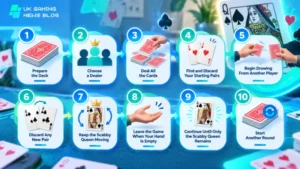
Scabby Queen is easy to learn because each turn follows the same pattern: make pairs, draw a card and try to get rid of your entire hand. The main objective is to avoid being the player left holding the Queen of Spades at the end.
Step 1: Prepare the Deck
Start with a standard 52-card pack and remove any Jokers. Then remove the Queen of Clubs from the deck.
This leaves 51 cards in play and makes the Queen of Spades the Scabby Queen because it cannot form its normal queen pair.
Example:
The Queen of Hearts can eventually be paired with another queen, but the Queen of Spades is intended to remain as the final unmatched card.
Step 2: Choose a Dealer
Choose one player to deal the first round. You can select the dealer randomly, have everyone draw a card and let the highest card deal, or simply choose someone to begin.
The dealer should shuffle the remaining cards thoroughly before dealing.
Step 3: Deal All the Cards
The dealer gives out the entire deck one card at a time around the group.
It does not matter if the cards cannot be divided equally. With some numbers of players, one or two people may receive an extra card.
Players should keep their cards hidden from everyone else.
Example:
If four people are playing with 51 cards, three players may receive 13 cards while one player receives 12. The game can still continue normally.
Step 4: Find and Discard Your Starting Pairs
Before anyone starts drawing cards, every player checks their hand for matching pairs.
A pair is made from two cards of the same rank. The suits do not need to match.
For example:
- 7 of Hearts + 7 of Clubs = a pair
- King of Diamonds + King of Spades = a pair
- 4 of Clubs + 4 of Hearts = a pair
Place completed pairs on the table and remove them from your hand.
If you have three cards of the same rank, discard two as a pair and keep the third. If you have all four cards of one rank, you can discard them as two separate pairs.
Step 5: Begin Drawing From Another Player
Once everyone has removed their starting pairs, the drawing stage begins.
One player holds their remaining cards so the backs face the next player. The next player chooses one card without seeing its face.
The selected card is then added to the drawing player’s hand.
Example:
Suppose you are holding a 9 of Hearts. You draw a hidden card from the player beside you and discover that it is the 9 of Spades. You now have a pair of 9s, so both cards can immediately be discarded.
Step 6: Discard Any New Pair
After drawing a card, check whether it matches the rank of another card already in your hand.
If it creates a pair, place both matching cards down immediately.
If it does not create a pair, simply keep the new card in your hand.
The player who has just completed their turn then presents their cards to the next player, and the same process continues around the group.
Step 7: Keep the Scabby Queen Moving
During the game, someone will be holding the Queen of Spades.
That does not mean they have already lost. Another player may randomly draw the Queen of Spades from their hand later, causing the Scabby Queen to change owners.
Example:
Anna has the Queen of Spades. Ben chooses a hidden card from Anna’s hand and accidentally picks the Queen of Spades. Ben now holds the Scabby Queen, while Anna may be able to get rid of her remaining cards.
This uncertainty is what creates much of the suspense in the game.
Step 8: Leave the Game When Your Hand Is Empty
Whenever a player manages to discard all of their cards, they are safe for that round.
They no longer need to draw or offer cards. The remaining players continue playing in the same way.
As more players empty their hands, fewer cards remain and it becomes increasingly difficult to avoid the Scabby Queen.
Step 9: Continue Until Only the Scabby Queen Remains
Players continue drawing hidden cards and discarding pairs until every possible pair has disappeared.
Eventually, only one card should remain: the Queen of Spades.
The player holding it is the loser of the round.
For example, if Alice and James are the final two players and Alice has two cards while James has one, James draws from Alice. If he makes a pair and discards it, Alice may be left holding only the Queen of Spades. Alice therefore becomes the Scabby Queen for that round.
Step 10: Start Another Round
Collect all the cards, return the Queen of Clubs to the deck temporarily if needed to organise the pack, then prepare the deck again for another round.
Players can simply play for fun and keep track of how many rounds each person loses. No scoring system is required.
Some traditional versions of Scabby Queen included a physical forfeit for the losing player, but this is not necessary for the card game itself.
For family or casual play, a harmless alternative such as keeping a loss tally, performing a funny challenge or dealing the next round keeps the game enjoyable for everyone.
The basic pattern is therefore simple: discard your pairs, draw a hidden card, discard any new pair and avoid finishing with the Queen of Spades.
What Are the Rules of Scabby Queen?
Four rules keep this version consistent: draw without looking, pair by rank and colour, discard pairs as they arise, and leave the Queen of Spades in play until the end.
The Basic Drawing Rule
A player takes one hidden card from the next active player’s offered hand. The person offering cards shows their backs, not their faces, and allows a free choice.
The Pairing Rule
Only cards of the same rank and colour make a pair. Suits within that colour differ: hearts pair with diamonds, while clubs pair with spades.
The Final-Card Rule
With the correct pack and pairing method, exactly one card remains after all pairs are discarded: the Queen of Spades. If several cards cannot be paired, check for a missing card or an incorrect discard.
Winning and Losing Conditions
A player is safe as soon as their hand is empty. The person holding the Queen of Spades at the end loses. The group may call the first player out the winner, but that is an optional house rule.
Which Scabby Queen Rule Is the Most Important and Why?
Pair cards by rank and colour after removing the Queen of Clubs. This leaves the Queen of Spades without a matching partner, so it is the only card that cannot be discarded. If players pair by rank alone, the Queen of Spades could be discarded with a red queen.
Quick Rules Checklist
- Remove the Queen of Clubs and any jokers, then deal all 51 cards.
- Discard pairs of the same rank and colour.
- The dealer offers their cards face down to the player on the left.
- Each player draws one unseen card, discards any new pair, then offers their hand to the next active player on the left.
- Skip empty-handed players. The final holder of the Queen of Spades
What Tricks and Tactics Can You Use in Scabby Queen?
Draws are mostly down to luck because card faces are hidden. Players can still avoid giving away clues and follow the round more carefully:
- Rearrange your hand before offering it so the Queen of Spades does not stay in a recognisable position. Offer every card and let the next player choose freely.
- Keep your reaction neutral when you draw a card or someone reaches towards your hand.
- Watch discarded pairs and draws. Remembering cards you have seen can help you spot a mistaken pair, but it cannot tell you with certainty who holds a hidden card now.
No tactic guarantees a win; the final draw may still decide who holds the queen.
Which Card Is Important in Scabby Queen?
The Queen of Spades determines the result in the version explained here. Other cards matter because they form pairs that allow players to leave the round.
The Unmatched Queen
The Queen of Spades has no black partner after the Queen of Clubs is removed. It cannot be paired or discarded legitimately during the round.
Identifying the Scabby Queen
Check the queen’s spade symbol and black suit. The Queen of Hearts and Queen of Diamonds are red and can pair with one another. The Queen of Clubs should be outside the pack.
Which Game Was Replaced by Scabby Queen?
There is no clear evidence that Scabby Queen replaced another game. It is better understood as a regional or family version of the wider Old Maid tradition.
Scabby Queen is associated with Scottish play, while related games elsewhere may use a different name, unmatched card or forfeit. These shared features show how closely the games are related without establishing that one replaced the other.
What Is Old Maid?
Old Maid is a card game in which players discard pairs and try to avoid being left with the one card that has no partner. Players deal the cards, remove their starting pairs, then take turns drawing unseen cards from one another and discarding any new pairs.
Some Old Maid decks include a specially labelled unwanted card. With a standard pack, players create one by removing a card and agreeing on how pairs are matched. In the Scabby Queen rules described here, that final unmatched card is the Queen of Spades.
What Is the Difference Between Old Maid and Scabby Queen?
The main distinction is the chosen card and local tradition, rather than a completely different way of playing. This guide’s Scabby Queen version names the Queen of Spades as the unwanted card.
Similarities Between the Games
| Feature | Scabby Queen in this guide | Old Maid generally |
| Main action | Draw cards and discard pairs | Draw cards and discard pairs |
| Unwanted card | Queen of Spades | An unmatched card chosen by the deck or rules |
| End of round | One player holds the last card | One player holds the last card |
| Scoring | Optional | Optional |
Both can be played without a physical forfeit. Families may use the names differently, so the rules agreed at the table matter more than the label.
What Are the Common Variations of Scabby Queen?
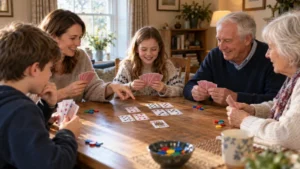
Variations are fine when everyone understands them before the first deal. Agree on the deck, pairing method, turn direction and losing card in advance. Changing any of these during a round can make the ending unclear.
Different Queen Rules
The Queen of Spades does not have to be the losing card. When matching by rank and colour, a group can remove a different queen and leave its same-colour partner unmatched. For example, removing the Queen of Spades leaves the Queen of Clubs without a partner.
Some groups instead pair cards by rank alone, regardless of colour. If one queen is removed, the remaining three queens can form one pair, leaving one queen behind.
The final queen cannot be guaranteed because players may choose different pairs from those three cards.
Joker Variations
A joker can take the place of the unmatched queen, but the other cards must still form complete pairs. Start with a standard deck, remove both black queens and add one joker.
The result is 51 cards: 25 rank-and-colour pairs and one unmatched joker. Whoever holds the joker after all pairs have been discarded loses.
Agree on this setup before shuffling. Adding a joker to the usual Queen of Spades pack would leave both the joker and the Queen of Spades unmatched.
Regional House Rules
House rules can change how a round is played without changing which cards form pairs.
A group might draw to the right instead of the left, place discarded pairs face down, or play several rounds and count each player’s losses. If pairs are placed face down, players should still show both cards as they discard them so everyone can check that they match.
Some traditional versions include raps, a physical forfeit for the loser. A forfeit is optional. Groups can leave it out or choose a harmless task, such as having the losing player deal the next round.
FAQs About Scabby Queen
Can Scabby Queen be played without a forfeit?
Yes. The card game works without one; the final queen-holder simply loses the round.
What happens if someone forgets to discard a pair?
In a casual game, they can show and discard it when the mistake is noticed, then continue.
Can the Queen of Spades change hands?
Yes. It can be drawn repeatedly. Its holder only loses if they still have it at the end.
Do players draw from a central pile?
No. All cards are dealt at the start, and players draw from one another’s hidden hands.
Why are two cards left at the end of our game?
Check for an incorrect pair, a missing card or a joker left in the pack. The stated setup should leave only the Queen of Spades.
Which queen should be removed before playing?
Remove the Queen of Clubs. Keep the Queen of Spades as the unmatched card.
How many people can play Scabby Queen?
Two or more can play, though three or more lets the queen pass between more players.
Do matching cards need the same suit?
No. In this version, they need the same rank and colour, such as the 5 of Hearts and 5 of Diamonds.
Is Scabby Queen the same as Old Maid?
They use the same draw-and-pair idea. Scabby Queen names a queen as the unwanted card, while Old Maid decks and house rules may use a different card.
Related Articles: