
Dobble is one of the easiest card games to learn but surprisingly difficult to master. Its fast-paced gameplay challenges players to identify matching symbols before their opponents, making it popular for family gatherings, parties and quick gaming sessions.
What makes Dobble particularly interesting is that every two cards share exactly one matching symbol, regardless of which cards are selected.
Although the basic concept takes seconds to understand, the game offers five different ways to play, each with its own setup, objectives and winning conditions.
Whether playing with two people or a larger group, understanding the rules, card combinations and practical strategies can make every round more enjoyable.
What Is Dobble and How Does the Game Work?
Dobble, also known as Spot It! in several international markets, is a visual recognition card game originally launched in France in 2009.
Denis Blanchot and Jacques Cottereau were central to its development, building on a mathematical card-matching concept.
Unlike traditional card games involving numbers, suits or complex scoring systems, Dobble challenges players to recognise matching images under time pressure.
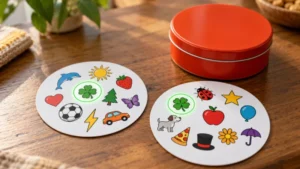
The classic game contains 55 circular cards, each displaying eight symbols. These include familiar objects, animals and colourful illustrations.
The fundamental rule is straightforward: any two cards contain exactly one identical symbol, although its size and position may differ.
Players must identify that symbol, announce it aloud and complete the required action before their opponents.
Dobble Quick Facts
| Feature | Classic Dobble |
| Game type | Speed and observation card game |
| Players | 2–8 |
| Recommended age | 6+ |
| Playing time | Approximately 15 minutes |
| Number of cards | 55 |
| Symbols per card | 8 |
| Matching symbols between two cards | Exactly 1 |
| Mini-games | 5 in the current UK rules |
| Difficulty | Beginner-friendly |
| Typical UK RRP | £13.99 |
The compact travel tin makes Dobble particularly convenient for holidays, family evenings and short breaks.
How Do You Set Up Dobble Before Playing?
Setting up Dobble requires very little preparation, although the arrangement changes depending on the selected mini-game.
For beginners, Towering Inferno is generally the simplest starting point.
Follow these steps:
- Open the tin and remove the circular cards.
- Shuffle the deck thoroughly.
- Choose one of the five mini-games.
- Arrange the cards according to that game’s instructions.
- Position everyone where they can clearly see the playing area.
- Explain how matching symbols are identified.
- Begin simultaneously when everyone is ready.
Before playing competitively, place two random cards face up and ask participants to identify their matching symbol.
Repeat with different cards until everyone understands the central mechanic.
The images must match in shape and colour. A large green symbol and a smaller green version of the same symbol count as a match.
However, two objects that merely resemble each other are not automatically matching symbols.
Important: Dobble is played simultaneously. Players do not normally take turns identifying matches.
What Are the Five Official Dobble Mini-Games?
The five mini-games described in the current UK publisher instructions are:
- Towering Inferno
- The Well
- Hot Potato
- Gotta Catch Them All
- Poisoned Gift
Each changes the way players collect, discard or pass cards.
Some older rulebooks and alternative editions contain different selections, including Triplet. The instructions supplied with a particular edition should take priority.
1. How Do You Play Towering Inferno?
Towering Inferno is an ideal introduction because everyone races to collect cards from one central pile.
Objective: Finish with the most cards.
Setup
Shuffle the deck and deal one card face down to every player.
Place the remaining cards face up in a central draw pile, ensuring everyone can reach it comfortably.
Gameplay
- Everyone turns their personal card face up simultaneously.
- Players search for the matching symbol between their card and the visible central card.
- The first person to identify the match announces its name.
- That player takes the central card and places it face up on their personal pile.
- The next central card becomes visible immediately.
- Everyone continues comparing their current top card with the central card.
For example, if the centre card and your personal card both display a matching lightning bolt, call out “Lightning!” and collect the central card.
The game continues until the middle pile is empty.
Winning condition: The player who has collected the most cards wins.
Practical tip: Keep your personal pile organised so that only its top card is visible.
2. How Do You Play The Well?
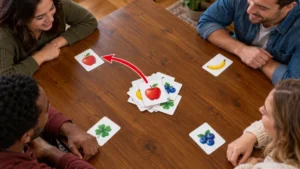
The Well reverses the basic objective of Towering Inferno.
Instead of collecting cards, players race to discard them.
Objective: Be the first player to eliminate your entire pile.
Setup
Place one card face up in the centre.
Distribute the remaining cards as evenly as possible into equal-sized, face-down personal piles. Set aside any spare cards that cannot be distributed equally.
Gameplay
- Every player turns their personal pile face up, revealing the top card.
- Look for the matching symbol between your top card and the central card.
- Announce the matching symbol immediately.
- Place your top card onto the central pile.
- The discarded card becomes the new central card.
- Continue comparing your newly exposed top card against the changing centre.
Because the central card changes whenever somebody discards successfully, players must constantly adjust their attention.
Winning condition: The first person to discard every card wins. The last person remaining is the loser.
The Well becomes especially competitive when several players notice different matches almost simultaneously.
Practical tip: Avoid studying the centre card for too long. It can change before you act.
3. How Do You Play Hot Potato?
Hot Potato is one of Dobble’s quickest and most energetic mini-games.
It works particularly well with four or more players because there are more potential opponents to target.
Objective: Avoid being left holding cards at the end of each round.
Setup
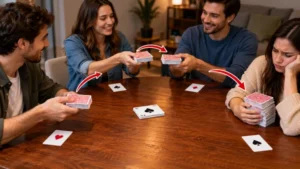
Deal one card face down to every player.
Players hold their cards in their hands so that the symbols can be displayed simultaneously.
Gameplay
- Everyone turns their card face up at the same moment.
- Search for a matching symbol between your card and another player’s visible card.
- Announce the symbol when you spot it.
- Place your card onto that opponent’s card.
- The receiving player now holds the combined stack.
- That player can pass their entire stack onto another player’s card after identifying a matching symbol.
- Continue until only one person remains holding all the cards.
That final player loses the round and keeps the collected cards as penalty cards.
Shuffle or deal fresh cards to begin another round.
The publisher recommends playing approximately five rounds, although groups can continue for longer.
Winning condition: The player with the fewest accumulated penalty cards across the rounds wins.
Practical tip: Look towards opponents who still hold single cards, rather than wasting time watching someone who has already passed their stack away.
4. How Do You Play Gotta Catch Them All?
Gotta Catch Them All encourages everyone to compete for several available cards rather than concentrating on one opponent.
Objective: Collect the most cards across multiple rounds.
Setup
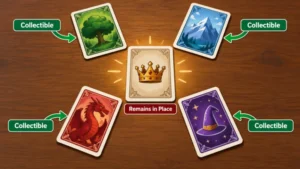
Place one card face up in the centre.
Deal one card face down to each player, arranging these around the central card.
Keep the remaining cards available for subsequent rounds.
Gameplay
- Players simultaneously reveal their surrounding cards.
- Compare the central card with any available outer card.
- Announce the matching symbol when identified.
- Collect that outer card.
- Continue claiming matching outer cards until none remain.
- Leave the central card untouched throughout the round.
- Replace the central card for the next round and deal fresh outer cards.
The essential rule is that players may take any available outer card, including another player’s starting card, but must never collect the centre card.
Previously won cards remain in each player’s collection across rounds.
Continue until the supply of cards has been exhausted.
Winning condition: The player who has collected the most cards wins.
Practical tip: Scan all outer cards rather than concentrating exclusively on the card initially dealt to you.
5. How Do You Play Poisoned Gift?
Poisoned Gift introduces a competitive twist because finding a match allows players to give unwanted cards to their opponents.
Objective: Finish with the fewest collected cards.
Setup
Deal one card face down to each player.
Place the remaining cards face up in a central draw pile.
Everyone reveals their personal card simultaneously.
Gameplay
- Look at the central card.
- Compare it with the visible top cards belonging to other players.
- Identify the matching symbol between the centre and an opponent’s card.
- Announce the symbol.
- Take the central card and place it on top of that opponent’s pile.
- The next central card becomes available.
- Repeat until the central pile is empty.
Unlike Towering Inferno, you are not attempting to collect the card yourself.
Instead, you are deliberately increasing another player’s collection.
Winning condition: The participant with the fewest cards at the end wins.
Practical tip: Keep an eye on which opponents already have large stacks, but do not spend so long choosing a target that somebody else claims the card first.

What Happens When Two Players Spot the Same Symbol?
Simultaneous announcements are common in Dobble, particularly when players become experienced.
The official tie-breaking principle is based on who completes the relevant card action first.
When two people announce the correct symbol together, the player who first takes or places the card wins that contested action.
If the overall game finishes in a tie between two players, they can resolve it through a one-card duel.
Each receives one card and reveals it simultaneously. The first to identify and announce the matching symbol wins.
For ties involving three or more players, the rulebook provides a Hot Potato round as the deciding challenge.
Players should agree on these rules before starting.
For safety and fairness, place the central cards where everyone can reach them without leaning across others or grabbing aggressively.
How Do You Play Dobble With Two Players?
Dobble works well with two participants, although the experience differs from playing in a larger group.
With only one opponent, every decision becomes a direct race.
Towering Inferno and The Well are particularly suitable because the objective is clear and the central card remains the focus.
For Towering Inferno:
- Give each player one face-down card.
- Place the remaining deck face up between them.
- Reveal both personal cards simultaneously.
- Race to identify the shared symbol with the central card.
- Continue until the central pile disappears.
The player collecting the most cards wins.
For a more competitive session, play three rounds and award one point for each victory.
Players who enjoy similarly fast card-based competition may also enjoy learning the Spit card game rules, where quick reactions and simultaneous play are equally important.
Which Dobble Mode Is Best for Different Player Counts?
Although classic Dobble officially supports two to eight players, some mini-games feel more enjoyable with particular group sizes.
| Mini-game | Suggested group size | Main objective |
| Towering Inferno | 2–8; especially good for beginners | Collect the most cards |
| The Well | 2–8; particularly good for smaller groups | Discard all cards first |
| Hot Potato | 4–8 preferred | Avoid penalty cards |
| Gotta Catch Them All | 3–6 preferred | Collect outer cards |
| Poisoned Gift | 3–8 preferred | Finish with the fewest cards |
These are practical recommendations rather than additional official restrictions.
For younger beginners, starting with one simple mini-game usually works better than switching continuously.
Larger groups may particularly enjoy Hot Potato because players can interact with several opponents.
Why Does Every Two Dobble Cards Have Exactly One Matching Symbol?
One of Dobble’s most fascinating features is the mathematics behind its card combinations.
The game uses a mathematical structure related to a finite projective plane, a concept from geometry and combinatorics.
In this system, symbols can be represented as points and cards as lines.
The arrangement is constructed so that any two lines intersect at exactly one point.
Translated into Dobble, this means that every pair of cards shares exactly one symbol.
Why Are There 55 Cards Instead of 57?
In the relevant mathematical construction, each card contains eight symbols.
This corresponds to a projective plane of order seven.
The total number of possible cards and distinct symbols in the complete structure is:
7² + 7 + 1 = 57
Therefore, a complete mathematical deck can contain 57 cards, each holding eight symbols, with exactly one match between every pair.
Classic Dobble contains 55 cards, meaning two cards are omitted from that complete construction.
Removing those cards does not affect the matching property.
There is an inconsistency in the publisher’s descriptions: one gameplay article refers to 50 available symbols, while its classic-game product information specifies 57.
The mathematical construction underlying the standard 55-card, eight-symbol deck uses 57 distinct symbols, so the 50-symbol description should not be treated as the definitive mathematical count.
This underlying system explains why choosing two completely random cards still produces exactly one matching illustration.
It is not coincidence or a manually chosen matching pair.
What Are the Best Strategies for Winning Dobble?
Although Dobble relies heavily on reaction speed, effective observation techniques can improve consistency.
Focus on the Other Card
Instead of repeatedly scanning your own familiar card, concentrate on whichever card is changing.
For Towering Inferno, memorise the positions of symbols on your top card briefly, then search the centre card for one of them.
In Poisoned Gift, concentrate on opponents’ cards because these determine where the central card can be placed.
Ignore Differences in Symbol Size
One of the most common mistakes is expecting identical symbols to appear at approximately the same size.
A tiny illustration can match a much larger version.
Train yourself to recognise shape and colour rather than size or position.
Learn the Less Familiar Symbols
Certain illustrations are recognised instantly, while others take longer to identify or name.
Practising unfamiliar symbols reduces hesitation.
A useful exercise is to select two cards, identify their shared symbol and immediately say its name aloud.
Repeat with several pairs until recognising and announcing the match feels natural.
Maintain a Good Playing Position
In mini-games involving the central pile, seating position can influence how quickly players complete card movements.
Keep the cards within comfortable reach and ensure everyone has equal access.
Avoid covering illustrations with your hands.
Prioritise Accuracy Over Panic
Calling an incorrect symbol does not produce a valid match.
Instead of shouting random guesses, follow a deliberate scanning pattern.
Begin with a few clearly recognisable symbols and search for their equivalents on the other card.
Once confident, announce the match and complete the required action.
What Common Mistakes Should Beginners Avoid?
New players often understand the matching mechanic but overlook the differences between mini-games.
Common mistakes include:
- Collecting cards in The Well when they should be discarded.
- Taking the centre card in Gotta Catch Them All.
- Forgetting that Hot Potato is scored through accumulated penalty cards.
- Comparing cards only by symbol size.
- Failing to announce the matching symbol.
- Continuing to examine a central card after another player has changed it.
- Forgetting which player wins when the round involves collecting the fewest cards.
The easiest solution is to explain the objective before every mini-game.
A short practice round can prevent confusion when moving between different rules.
What Is the Difference Between Dobble and Spot It!?
Dobble and Spot It! are regional names associated with the same underlying observation game.
Dobble originally launched in France in 2009, with later international releases introducing the Spot It! branding, particularly in North America.
Both use the distinctive mechanic in which two cards share exactly one matching symbol.
However, the illustrations, number of cards and included mini-games may vary between editions.
The important consideration when purchasing either product is whether it contains the classic matching deck or a themed variation.
Players familiar with one version should find the core gameplay of the other immediately recognisable.
What Are the Different Dobble Editions Available?
The Dobble range now includes several alternative versions for younger children, themed collections and more strategic gameplay.
| Edition | Age guidance | Main difference |
| Classic Dobble | 6+ | 55 cards, eight symbols per card |
| Dobble Kids | 4+ | 30 animal-themed cards |
| Dobble Connect | 8+ | 90 hexagonal cards with ten symbols each |
| Dobble Waterproof | 6+ | Durable plastic cards suitable for outdoor use |
| Dobble Bluey | 4+ | Bluey-themed illustrations |
| Dobble Marvel Emoji | Check packaging | Marvel-themed symbol matching |
| Dobble Disney Princess | Check packaging | Disney-themed illustrations |
Dobble Kids is particularly suitable for younger participants because its animal imagery and adapted game selection simplify the experience.
Waterproof Dobble is more practical for beaches, camping and outdoor holidays.
The licensed editions appeal to players who enjoy recognising favourite characters and themed objects.
How Is Dobble Connect Different?
Dobble Connect introduces an additional placement objective.
Rather than simply collecting or discarding circular cards, players use hexagonal cards to form a connected line of four in their own colour.
The game includes 90 hexagonal cards, with ten symbols displayed on each card.
Designed for two to eight players aged eight and above, it combines matching speed with positional decisions.
Players must recognise shared symbols, place their cards and potentially block opponents from completing a line.
Consequently, Dobble Connect involves more spatial strategy than classic Dobble.
Is Dobble Suitable for Every Player?
Dobble is accessible to many beginners because its rules require no reading, complex arithmetic or previous gaming experience.
However, it is not equally suitable for everyone.
The gameplay depends heavily on visual recognition, concentration, distinguishing illustrations and responding quickly.
Players with certain visual impairments or difficulties processing busy images may find the standard competitive format challenging.
Families can introduce house-rule adjustments, such as allowing additional time, reducing the number of competing players or practising without a timer.
For young children, Dobble Kids can provide a more appropriate introduction.
Dobble also works best as a short, energetic warm-up or family activity rather than a lengthy strategy experience.
Those seeking complex decision-making, evolving tactics or deeper resource management may prefer a different game.
Can You Play Dobble Online or on Mobile?
Yes. Dobble has an officially licensed mobile adaptation called Dobble GO!, developed by Amuzo in partnership with Asmodee Entertainment.
The game brings the familiar symbol-matching concept to mobile devices.
Depending on the available version, players can access solo challenges, multiplayer activities and additional features.
It includes gameplay systems that differ from the physical card game, including power-ups and progression-based challenges.
The mobile game is available for supported iOS and Android devices, although regional availability and platform requirements should be checked.
Online tabletop implementations also exist.
Players specifically wanting the five classic mini-games should check which modes a digital platform supports, rather than assuming every adaptation follows the physical rules exactly.
Where Can You Buy Dobble and Is It Worth Giving as a Gift?
Classic Dobble has a listed UK recommended retail price of £13.99, although shop prices may vary.
It is available through board-game retailers, toy shops and online stores.
Before buying, check the recommended age, edition, contents and whether the seller provides the appropriate English-language instructions.
Dobble can make a practical birthday or Christmas gift because it is compact, relatively inexpensive and suitable for mixed-age groups.
The classic edition is a sensible starting choice for most families.
Dobble Kids is better suited to younger children, while Connect may appeal to players who already enjoy the original and want an additional tactical element.
Frequently Asked Questions About Dobble
How many cards are in classic Dobble?
Classic Dobble contains 55 circular cards. Each card displays eight different symbols, and every pair shares exactly one matching symbol.
How many different symbols are in Dobble?
The underlying mathematical construction uses 57 distinct symbols. Some publisher descriptions refer to 50, but the complete 57-symbol construction corresponds to the standard eight-symbol matching system.
How long does a game of Dobble take?
A typical session takes approximately 15 minutes. Individual mini-games can finish much faster, particularly Hot Potato.
Can two people play Dobble?
Yes. Classic Dobble supports two to eight players. Towering Inferno and The Well are especially convenient for two-player matches.
Is Dobble suitable for young children and beginners?
Classic Dobble is recommended for ages six and above. Dobble Kids is designed for children aged four and older.
What is the difference between Dobble and Spot It!?
They are different regional names for essentially the same symbol-matching game. Packaging, illustrations and included variations may differ.
What happens if two players shout the same symbol simultaneously?
The player who correctly completes the required card movement first wins the contested action. Overall ties can be resolved using a one-card duel.
Can matching symbols appear in different sizes or orientations?
Yes. Matching symbols can differ in size, position and presentation. Players should identify the same illustrated symbol rather than relying on its location or scale.
Is Dobble good for large groups?
Yes. The classic game supports up to eight players. Hot Potato and Poisoned Gift can be especially entertaining with larger groups.
What is the easiest Dobble mini-game to learn?
Towering Inferno is a strong starting choice. Players simply identify matching symbols and collect cards, making the objective easy to understand.