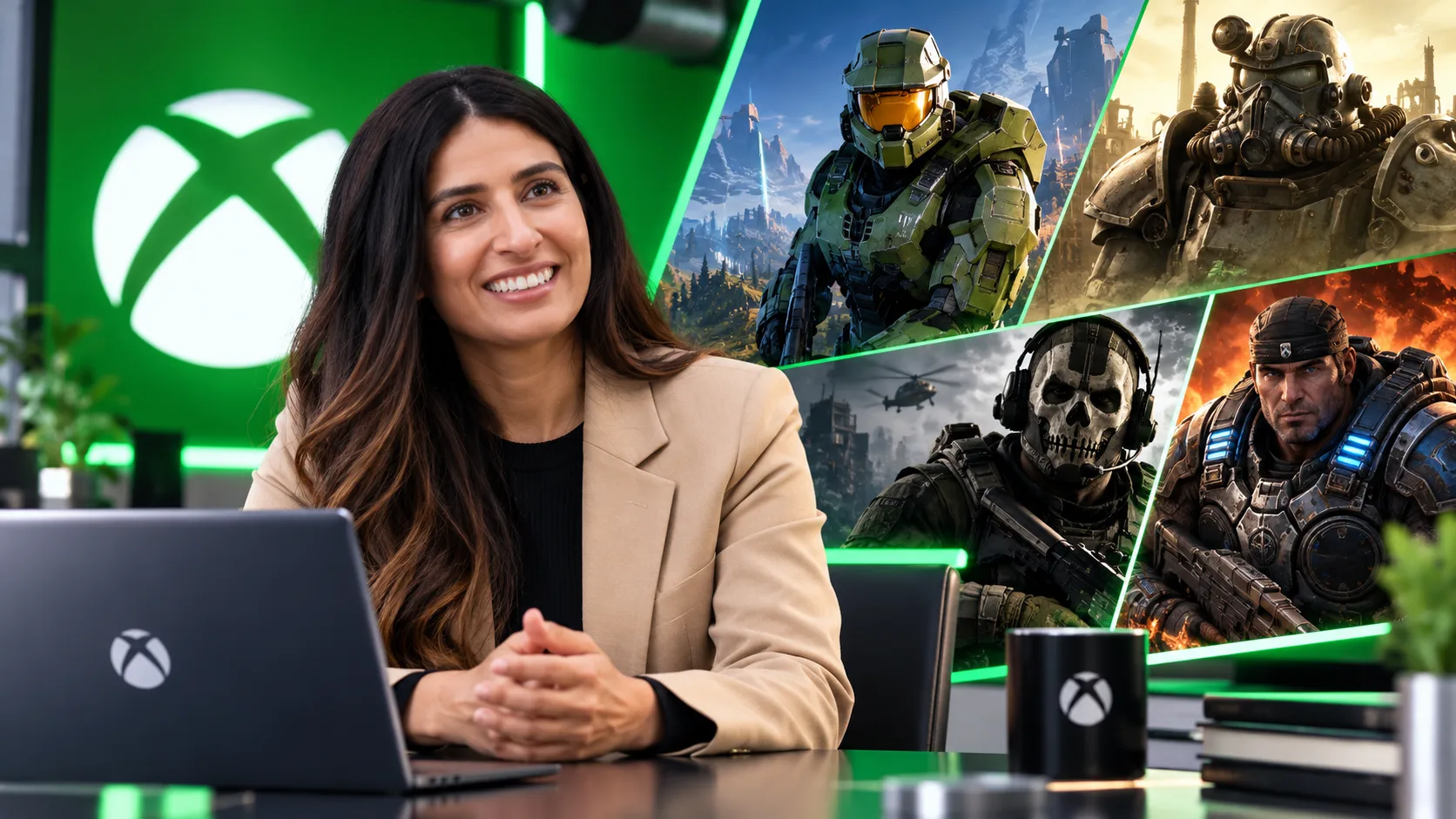
Xbox CEO Asha Sharma has outlined a major shift in Microsoft’s gaming strategy, warning that the company cannot secure its future by relying exclusively on established franchises such as Halo, Fallout, Call of Duty and Gears of War.
Speaking during an internal Xbox town hall held on 6 October 2026, Sharma reportedly told employees that Microsoft intends to transform its strongest gaming properties into global billion-dollar franchises while continuing to invest in entirely new intellectual property (IP).
Her remarks, first detailed by Windows Central using internal transcripts obtained from multiple sources, come at a particularly difficult moment for Xbox.
The company has undergone substantial restructuring, reduced its workforce and separated from several studios previously associated with experimental and original games.
The message presents an important challenge for Microsoft’s gaming division: Xbox wants to extract more value from its most successful franchises without losing the creativity required to develop the next generation of major gaming properties.
For players, developers and the wider gaming industry, Asha Sharma’s Xbox franchises strategy is becoming one of the most closely watched aspects of Microsoft’s ongoing gaming transformation.
Asha Sharma Warns Xbox Cannot Build Its Future on Existing Franchises Alone
Sharma’s comments suggest that Microsoft is attempting to balance two competing priorities: protecting established gaming franchises that generate substantial revenue and developing original games capable of attracting audiences who may not already be invested in Xbox.
During the town hall, she reportedly reaffirmed her ambition to build major international gaming brands. However, she also warned against depending entirely on the commercial achievements of the past.
“We will not survive if we only revive on the past,” Sharma said, according to the transcript reported by Windows Central.
The statement is significant because Microsoft’s recent restructuring has placed greater emphasis on successful and recognisable intellectual property.
Franchises including Call of Duty, Minecraft, Fallout, Forza, Halo, World of Warcraft and Candy Crush already give Microsoft access to audiences across consoles, PC, mobile devices and other entertainment platforms.
Yet Sharma’s comments acknowledge a fundamental weakness in any strategy built exclusively around familiar characters and established game worlds.
Even the industry’s strongest franchises eventually face changing player preferences, increasing development costs and competition from entirely new gaming experiences.
Games that become cultural phenomena often begin as original ideas rather than extensions of existing franchises. Minecraft, for example, was once a comparatively small independent project before developing into one of the most commercially successful gaming properties in history.
Xbox therefore faces a problem that cannot be solved simply by releasing more sequels or expanding existing brands.
It needs to identify which new ideas could become equally valuable over the next decade.
That requires creative freedom, development investment and a willingness to support projects whose commercial potential may not be immediately obvious.
Microsoft’s Billion-Dollar Ambition Comes After Major Studio Cuts
The timing of Sharma’s comments has attracted particular attention because Xbox spent much of 2026 reorganising its development operations.
In July, Microsoft announced plans to eliminate approximately 3,200 Xbox roles over its 2027 financial year, including around 1,600 immediate reductions.
The restructuring also involved the separation of several studios from Microsoft, while other development teams were placed under different publishing organisations.
By September, Microsoft had confirmed that Double Fine Productions and Compulsion Games had returned to independent management, retaining their intellectual property and receiving financial support for future projects.
Undead Labs subsequently transitioned to new ownership, with State of Decay 3 remaining scheduled for release through a new publishing arrangement.
Ninja Theory faced a different situation. After two proposed ownership agreements fell through, Microsoft began employee consultation over a potential closure while continuing to consider alternatives.
These developments have raised questions about how Xbox plans to support original game development after reducing or divesting teams previously associated with distinctive creative projects.
The earlier Xbox Game Studios leadership changes also highlighted concerns about management stability and the future direction of Microsoft’s first-party development network.
Sharma’s latest comments do not resolve those questions.
Instead, they make the distinction between Microsoft’s stated ambitions and its actual investment decisions increasingly important.
A company can acknowledge the value of new intellectual property while still choosing to concentrate most of its resources on established franchises.
The critical issue is whether Xbox’s remaining studios will receive sufficient time, funding and independence to pursue original concepts.
There is also a commercial tension. Original games can require years of development without any guarantee of strong sales, while successful existing franchises often provide more predictable revenue.
For Microsoft’s leadership, this creates pressure to demonstrate financial discipline while simultaneously taking the creative risks needed to identify future hits.
That balance may ultimately determine whether Sharma’s strategy delivers lasting growth.
Halo, Fallout and Forza Are Already at the Centre of Xbox’s Restructuring
Microsoft’s September 2026 organisational update provides a clearer picture of how its biggest franchises are being prioritised.
Activision received expanded responsibilities, including oversight involving Rare and World’s Edge, while a new Activision team was assigned development of the next Halo game.
Bethesda expanded its remit to include Obsidian Entertainment, with the studio continuing existing projects alongside work connected to the Fallout franchise.
Meanwhile, Playground Games and Turn 10 Studios were brought together as a single operation focused on Forza and Fable.
King also gained responsibility for Microsoft Casual Games, reinforcing the importance of mobile and casual audiences within Microsoft’s wider portfolio.
These changes show that Sharma’s billion-dollar franchise ambitions are already influencing the structure of Xbox’s development business.
Microsoft appears increasingly interested in organising teams around its most commercially important properties rather than maintaining a large collection of comparatively independent studios.
The potential benefits include clearer responsibilities, closer collaboration and more focused franchise planning.
However, there are risks.
Concentrating development resources around existing brands could reduce the diversity of Xbox’s games catalogue, particularly if original projects struggle to compete for investment against franchises with established audiences.
For players who have followed the changing most-played games across Xbox and PlayStation, the wider challenge is apparent: established live-service titles compete heavily for attention, and a recognisable franchise name alone does not guarantee continued player engagement.
Xbox must therefore do more than preserve its existing audience. It needs new experiences compelling enough to attract players who currently spend their time elsewhere.
Xbox’s New XP Division Reveals a Bigger Entertainment Strategy
Sharma’s comments also arrive less than a week after Microsoft officially announced XP, a new Xbox division designed to expand gaming franchises into other entertainment markets.
Unveiled on 8 October 2026, XP brings together Microsoft’s efforts in film, television, consumer products, strategic partnerships and live experiences.
The division is led by Kayleen Walters, previously associated with Mojang and the development of Minecraft as a broader entertainment property.
Matthew Ball, Xbox’s chief strategy officer, described the new initiative as part of the company’s ambition to become a leading global entertainment business.
Rather than measuring a franchise’s value exclusively through video game sales, Microsoft wants successful gaming properties to reach audiences through several different formats.
The four operating areas cover Xbox Pictures for screen entertainment, Xbox Products for merchandise, Xbox Places for live and immersive experiences, and Xbox Partnerships for collaborations with brands and creators.
This broader approach helps explain why Sharma is placing such strong emphasis on billion-dollar franchises.
Microsoft is not necessarily aiming for every successful game to become a billion-dollar title through game purchases alone.
It wants intellectual property that can generate long-term value through gaming, licensing, entertainment and consumer engagement.
Minecraft provides an obvious example of this model, having expanded far beyond its original game into films, merchandise and other experiences.
The strategy also reflects a wider industry movement in which gaming companies increasingly treat their characters, fictional worlds and communities as entertainment assets.
Nintendo has pursued a related approach, with Shigeru Miyamoto’s game and movie strategy illustrating how familiar gaming characters can reach new audiences through cinema while continuing to influence future games.
For Xbox, the opportunity is considerable, particularly across franchises such as Fallout, Halo, Minecraft and Call of Duty.
However, XP also adds another dimension to the debate over original games.
If Microsoft wants a greater number of valuable entertainment franchises, it must first create the gaming experiences from which those franchises can grow.
Film adaptations and merchandise can expand an existing fanbase, but they cannot replace the original creative development that makes a new property successful.
Clockwork Revolution Could Become an Important Test for New Xbox IP
One upcoming title stands out as a potential indication of whether Microsoft remains committed to ambitious original games.
Clockwork Revolution, the steampunk role-playing game developed by inXile Entertainment, is currently scheduled for release in 2027.
Unlike Halo, Fallout or Gears of War, it is not a sequel to an established franchise.
The game introduces a new fictional world, Avalon, where players can manipulate time and influence the consequences of major decisions.
Its combination of time-travel mechanics, reactive storytelling and role-playing systems gives Microsoft an opportunity to establish a distinctive new gaming property.
Importantly, Clockwork Revolution remains an Xbox Game Studios-published project and is planned for Xbox Series X|S, PC and Game Pass.
Its development suggests that Microsoft’s first-party strategy has not abandoned original intellectual property entirely.
Nevertheless, one ambitious title cannot demonstrate the long-term health of Xbox’s original development pipeline.
The more important measure will be how Microsoft supports new projects after launch, especially those that achieve critical recognition without immediately becoming enormous commercial successes.
Many enduring gaming franchises require multiple releases to establish their identity and develop a loyal audience.
If Xbox expects every new project to become a billion-dollar property immediately, it may struggle to create the conditions necessary for those franchises to emerge.
Sharma’s challenge is therefore not simply to identify promising original games.
It is to build a development and publishing environment where successful new ideas have enough time to grow.
Game Pass and the Next Xbox Could Determine Whether the Strategy Works

The implications of Microsoft’s renewed franchise focus extend beyond game development.
Xbox’s commercial ecosystem includes subscriptions, console hardware, PC gaming, cloud gaming and digital distribution.
These services offer different routes for existing and original franchises to reach players.
A major new game could encourage Xbox console purchases, attract PC customers, generate direct sales or contribute to subscription engagement.
However, those outcomes depend on release strategy, pricing and the availability of games across different platforms.
The changing structure of Xbox Game Pass Premium and Ultimate is particularly relevant because Microsoft’s subscription offering has undergone major revisions during 2026.
A steady flow of new games remains important to the service’s appeal, but Xbox must also consider whether titles deliver sufficient commercial returns through direct purchases and other revenue sources.
At the same time, the future of Microsoft’s console business remains closely connected to the strength of its first-party catalogue.
As discussion continues around the next Xbox console’s release, exclusive experiences, franchise recognition and the availability of compelling new games could all influence whether players remain invested in Xbox hardware.
The difficulty is that a subscription service benefits from variety, while a franchise-focused investment model may encourage Microsoft to spend more heavily on fewer projects.
Sharma’s strategy will need to satisfy both requirements.
Players expect access to familiar blockbuster franchises, but they also need compelling reasons to explore something new.
A catalogue dominated by sequels and established live-service properties may be commercially attractive in the short term without necessarily delivering the originality required for long-term growth.
Xbox’s Future Now Depends on Turning Its Ambitions Into New Games
Sharma’s reported remarks signal that Microsoft’s leadership recognises the dangers of depending exclusively on the achievements of previous generations.
The company has valuable intellectual property, an extensive publishing network and opportunities to reach audiences well beyond traditional Xbox consoles.
Its new XP division provides a framework for transforming successful gaming properties into broader entertainment brands.
Meanwhile, the studio restructuring demonstrates Microsoft’s determination to control costs and concentrate resources around strategically important franchises.
What remains less clear is how much investment will be available for original projects that do not immediately fit the company’s billion-dollar ambitions.
For developers, the question is whether Microsoft’s tighter organisational structure will still allow sufficient creative experimentation.
For players, the answer will become visible through future game announcements, development decisions and the balance between new franchises and established releases.
Clockwork Revolution is one important title to watch, but the broader pipeline of original games will provide a more meaningful indication of Microsoft’s direction.
Sharma has identified the need for new intellectual property as essential to Xbox’s survival.
The next test is whether Microsoft can demonstrate that commitment through the games it chooses to develop, finance and release.
With restructuring still reshaping Xbox’s studios and a new entertainment division preparing to expand its biggest franchises, the direction of Microsoft’s gaming business is becoming clearer.
Its existing franchises may provide the financial foundation for the next decade, but its ability to create new ones could determine whether Xbox remains competitive beyond it.