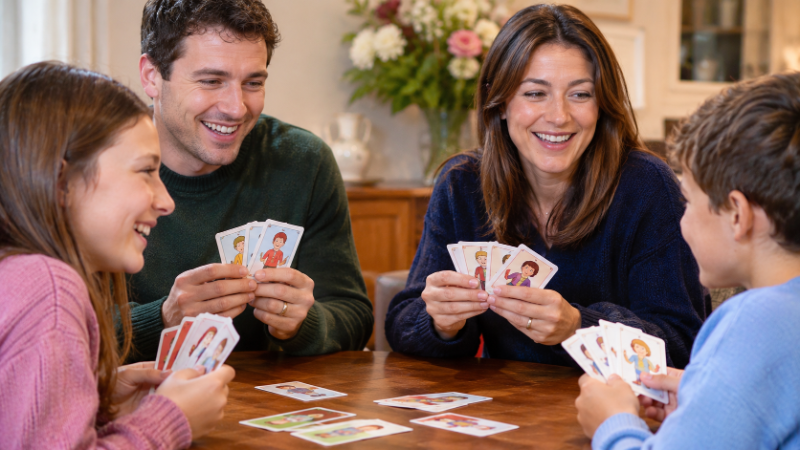
Happy Families is a traditional British card game in which players compete to collect complete families of four cards.
Players take turns asking their opponents for specific family members, remembering which cards have been requested and building matching sets until all families have been collected.
The game is easy to learn, making it suitable for children, beginners and family gatherings. However, winning consistently requires more than luck.
Remembering opponents’ cards, choosing the right person to question and completing families at the right opportunity can improve your chances of winning.
Whether you are using a traditional 44-card deck or a modern 32-card version, this guide explains how to play Happy Families step by step, including the setup, essential rules, different variations, scoring and practical strategies.
What Is the Happy Families Card Game?
Happy Families is a card-collecting game in which players attempt to gather all four members of particular families.
Each family has a shared name, occupation, colour or symbol, making it possible to identify the cards that belong together.
In traditional British editions, a family might include:
- Mr Bun – the Baker
- Mrs Bun – the Baker’s Wife
- Master Bun – the Baker’s Son
- Miss Bun – the Baker’s Daughter
Collecting these four cards completes the Bun family. The player places the completed set on the table and receives one point towards their final score.
Modern versions sometimes replace these characters with animals, professions, fictional characters or other themes.
Unlike card games such as Scabby Queen, where players try to avoid being left with an unmatched card, Happy Families rewards players for completing as many matching sets as possible.
Happy Families Game Overview
| Feature | Details |
| Game type | Family collection and memory card game |
| Number of players | 2 or more |
| Ideal group size | Approximately 3–4 players |
| Traditional deck | 44 cards |
| Common modern deck | 32 cards |
| Cards per family | 4 |
| Families in a 32-card deck | 8 |
| Families in a 44-card deck | 11 |
| Approximate playing time | 10–20 minutes, depending on the group |
| Suggested age | Around 4–5 years and above, depending on the edition |
| Main objective | Collect the most complete families |
| Main skills | Memory, observation, deduction and communication |
What Do You Need to Play Happy Families?
You need a Happy Families card deck and at least two players. A table or other flat surface is useful for dealing the cards and displaying completed families.
The game does not require dice, counters, a board or electronic equipment.
How Many Cards Are in Happy Families?
The number of cards depends on the edition.
The original British Happy Families deck contained 44 cards divided into 11 families. Many modern decks instead contain 32 cards divided into eight families.
| Deck version | Total cards | Families | Cards per family |
| Traditional British deck | 44 | 11 | 4 |
| Modern simplified deck | 32 | 8 | 4 |
| Custom small deck | 24 | 6 | 4 |
| Custom beginner deck | 16 | 4 | 4 |
All these versions follow the same basic collection objective.
The important requirement is that every family contains the correct number of members and no cards are missing.
For example, if your set includes eight families, you should have exactly 32 cards before dealing.
How Do You Set Up Happy Families?
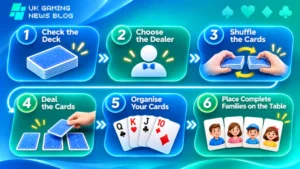
Preparing Happy Families normally takes only a few minutes.
Step 1: Check the Deck
Start by checking how many families are included in your deck.
Make sure each family contains four different members. If a card is missing, that family cannot be completed, which could prevent the game from finishing properly.
Step 2: Choose the Dealer
Select one player to shuffle and distribute the cards.
The dealer can be chosen randomly, by agreement or by allowing the youngest player to deal first.
In the traditional version described here, the player sitting to the dealer’s left takes the opening turn.
Step 3: Shuffle the Cards
Shuffle the entire deck thoroughly so that the family members are distributed randomly.
This is important because cards from the same family should not automatically remain together from the previous game.
Step 4: Deal the Cards
Deal the cards face down, one at a time, to the players until the entire deck has been distributed.
If the cards cannot be divided equally, some players will receive one additional card.
For example, with a 32-card deck and three players, two players receive 11 cards and the remaining player receives 10.
These small differences are acceptable in the traditional full-deck version.
Step 5: Organise Your Cards
Every player looks at their own hand without showing it to their opponents.
Arrange the cards according to their families.
For example, if you have Mr Bun and Mrs Bun, place them next to each other so you can easily identify which family members are missing.
This makes it easier to decide which card to request on your first turn.
Step 6: Place Any Complete Families on the Table
Some rules allow players to reveal complete families immediately after dealing.
If you already hold all four members of one family, place them together on the table and count that family towards your score.
Agree on this rule before starting. For a beginner-friendly game, revealing complete families immediately is the simplest option.
You are now ready to play.
How to Play Happy Families Step by Step?
The main gameplay involves asking opponents for individual cards and continuing to ask questions whenever your requests are successful.
The following instructions use the traditional rule that a failed request passes the turn to the player who was asked.
Step 1: Start With the First Player
The player to the dealer’s left begins.
They examine their hand, identify a family they have started collecting and decide which missing family member they want to request.
For example, a player who holds Mrs Bun may decide to ask another player for Master Bun.
Step 2: Ask Another Player for a Specific Card
Choose one opponent and ask whether they have the exact family member you need.
For example:
“Sarah, do you have Master Bun the Baker?”
The question must identify a specific card rather than asking for an entire family.
Important rule: You must already hold at least one card from that family.
If you have Mrs Bun, you may ask for Mr Bun, Master Bun or Miss Bun.
However, if you do not have any cards from the Dose family, you cannot request one until you acquire a member of that family.
Step 3: Receive the Card If Your Opponent Has It
If the player you questioned holds the requested card, they must give it to you.
They cannot refuse, hide the card or exchange it for another.
You add the card to your hand.
For example, if Sarah has Master Bun, she must hand it over.
The successful player may then ask another question.
Step 4: Continue Asking After a Successful Request
Receiving the correct card allows you to continue your turn.
You can question the same opponent again or choose another player.
You may also switch to requesting a member of a different family, provided you already hold at least one card from that family.
There is normally no fixed limit to the number of successful questions you can ask during one turn.
Your turn continues until an opponent cannot provide the requested card.
Step 5: End Your Turn After an Unsuccessful Request
If the player does not have the requested card, they must answer:
“Not at home.”
This traditional phrase means the requested family member is not in that player’s hand.
Your turn ends immediately.
Under the version used in this guide, the player who answered “Not at home” takes the next turn.
For example, if you ask Daniel for Mr Dose and Daniel does not have it, Daniel becomes the next player to ask for cards.
Some editions instead pass play clockwise. Both versions exist, so agree on which rule to use before the game begins.
Step 6: Complete and Declare a Family
When you collect all four members of a family, announce that you have completed it.
For example:
“Complete Bun family!”
Place the four cards together on the table in front of you.
Completed families are removed from further card requests and count towards your final score.
Depending on the edition, they may be displayed face up or face down.
For beginners, face-up families make it easier to check everyone’s progress.
If you completed the family through a successful request, you can usually continue your turn until a request fails.
Step 7: Continue Until Every Family Is Complete
The game continues as players request cards, exchange family members and complete sets.
Eventually, all the cards will be arranged into completed families.
Once every family is complete, the game ends.
Players count their completed sets to determine the winner.
What Does a Complete Round of Happy Families Look Like?
Consider a game involving three players: Alice, Ben and Charlie.
Alice begins with two cards belonging to the Bun family:
- Mr Bun
- Mrs Bun
She needs Master Bun and Miss Bun to complete the family.
| Turn | Player’s action | Result |
| 1 | Alice asks Ben for Master Bun | Ben has the card and gives it to Alice |
| 2 | Alice asks Charlie for Miss Bun | Charlie has the card and gives it to Alice |
| 3 | Alice completes the Bun family | Four cards are placed on the table |
| 4 | Alice asks Ben for Mrs Dose | Ben does not have the card |
| 5 | Ben says “Not at home” | Alice’s turn ends and Ben plays next |
This example demonstrates three important rules.
First, players may ask multiple questions during a single turn.
Second, completing a family does not automatically end the turn.
Third, an unsuccessful request ends the turn, regardless of how many cards were collected beforehand.
How Do You Win Happy Families?
The winner is the player who collects the greatest number of complete families.
Each completed family is worth one point.
For example, in a game using eight families, the final result might look like this:
| Player | Completed families | Points |
| Alice | 4 | 4 |
| Ben | 3 | 3 |
| Charlie | 1 | 1 |
| Total | 8 | 8 |
Alice wins because she collected four complete families, more than any other player.
The total number of families collected must equal the number included in the deck.
What Happens If Two Players Tie?
A tie occurs when two or more players collect the same highest number of families.
For example, two players could each collect four families from an eight-family deck.
There is no need to invent an additional scoring system.
Players can declare a shared victory or play another game to determine the overall winner.
For a longer competition, record the number of completed families across several games and award victory to the player with the highest cumulative score.
How Do You Play Happy Families With Different Numbers of Players?
Happy Families works with different group sizes, although the number of players affects the pace, strategy and dealing arrangement.
How to Play Happy Families With 2 Players?
A two-player game is possible with either a traditional or a modern deck.
For the full-deck version, shuffle and distribute all the cards between the two players.
With 32 cards, each player receives 16.
With 44 cards, each receives 22.
The players then take turns asking each other for missing family members.
Because there is only one opponent, remembering which cards have been requested becomes particularly important.
Alternative two-player variation: Cartamundi’s published rules also describe dealing 10 cards to each player and placing the remaining cards in a central draw pile. In that version, players draw from the pile after unsuccessful requests.
This makes the game less dependent on knowing that every missing card is held by your only opponent.
How to Play Happy Families With 3 Players?
Three players create additional opportunities for deduction because the missing cards may be distributed between two opponents.
In a 32-card game:
- Player 1 receives 11 cards.
- Player 2 receives 11 cards.
- Player 3 receives 10 cards.
Players should focus on remembering which opponent asked for a particular family member and which opponent successfully received cards.
How to Play Happy Families With 4 Players?
Four players offer a balance between quick turns and strategic card collection.
For a 32-card deck, each player receives eight cards.
For a 44-card deck, each receives 11 cards.
With more opponents, players need to observe more information, but they also have additional opportunities to collect cards from different hands.
Happy Families Dealing Guide
| Players | 32-card deck | 44-card deck |
| 2 | 16 cards each | 22 cards each |
| 3 | 11, 11 and 10 cards | 15, 15 and 14 cards |
| 4 | 8 cards each | 11 cards each |
| 5 | Two players get 7; three get 6 | Four players get 9; one gets 8 |
| 6 | Two players get 6; four get 5 | Two players get 8; four get 7 |
These calculations assume the entire deck is distributed and no cards are retained in a draw pile.
For larger groups, a 44-card deck may be preferable because it provides more families and cards to collect.
What Are the Most Important Happy Families Rules?
Although different versions exist, the main rules are straightforward.
| Rule | Explanation |
| Requesting cards | Ask one named opponent for one specific family member |
| Family requirement | You must already hold at least one member of the family requested |
| Successful request | The opponent hands over the card |
| Additional turns | A successful request allows another question |
| Failed request | The opponent says “Not at home” |
| Turn changes | The asked player goes next in the version described here |
| Completed family | All four members must be collected |
| Scoring | One point for each complete family |
| Winning | The player with the most families wins |
The rules are designed to encourage observation and communication rather than physical speed.
For a contrasting family card game, Dobble rewards rapid visual recognition and matching, while Happy Families gives players time to think carefully before requesting a card.
What Are the Best Strategies for Winning Happy Families?
Happy Families involves luck because the starting hands are randomly dealt. However, players can use memory and deduction to make better decisions.
Remember Which Cards Other Players Request
Every question reveals information.
If Alice asks for Master Bun, you know she holds at least one card from the Bun family at that moment.
Even if her request fails, you have discovered something about her hand.
Listening to other players is one of the simplest ways to improve your decisions.
Pay Attention to Successful Exchanges
Whenever a player receives a requested card, everyone can see which card was transferred.
For example, if Ben gives Mrs Dose to Charlie, you know Charlie now holds Mrs Dose.
If you already have another Dose family member, you can request Mrs Dose from Charlie on your next opportunity.
This creates a strong advantage because you are using observed information rather than guessing.
However, remember that cards may change hands again before your turn.
Focus on Families That Are Almost Complete
If you already hold three members of one family, you only need one additional card to finish it.
Prioritising that family may help you secure a point before an opponent takes away one of your cards.
For example, holding Mr Bun, Mrs Bun and Master Bun means you only need Miss Bun.
A successful request allows you to immediately complete the set.
However, do not focus exclusively on one family when you have stronger information about cards belonging to another.
Observe Which Requests Fail
An unsuccessful request also provides information.
Suppose Alice asks Ben for Miss Bun, and Ben answers “Not at home”.
You now know that Ben does not hold Miss Bun at that moment.
If the card does not change hands, repeatedly asking Ben for it is unlikely to help.
Combine these negative clues with observed exchanges to narrow down where particular cards are located.
Avoid Revealing Too Much Information
Whenever you request a family member, opponents learn that you possess at least one card from that family.
This information may allow them to target your cards.
You cannot prevent all information from being revealed, but you can choose your questions carefully.
For example, when you have several families in your hand, requesting a card whose location you already know is generally better than making a random guess.
Keep Your Cards Organised
Sorting your hand by family reduces confusion and makes it easier to identify missing members.
It can also help you notice when another player gives you the final card needed to complete a family.
Keep your cards hidden from opponents while making sure you can read them comfortably.
These techniques are useful in many traditional card games, particularly those involving memory, card exchanges and strategic decisions.
What Are the Different Happy Families Game Variations?

Happy Families has been adapted into several forms.
Some editions use different cards, while others change how players receive cards and how turns progress.
Traditional No-Draw Version
In the traditional version, every card is dealt at the beginning.
Players collect family members directly from their opponents.
There is no draw pile, and the game finishes when all complete families have been placed on the table.
Happy Families With a Draw Pile
In this variation, players receive a smaller number of cards at the beginning.
The remaining cards are placed face down in the centre.
When an opponent cannot provide the requested card, the asking player draws from the pile.
Some versions allow another request if the drawn card matches the card just requested.
This variation shares several features with Go Fish.
Simplified Happy Families for Young Children
For younger players, use fewer families so the deck is easier to manage.
A simple beginner deck might contain four families, with four cards in each.
That produces a 16-card game.
Children can also begin by arranging visible cards into complete families before learning how to request hidden cards from opponents.
Once they understand the matching concept, introduce the normal questioning rules.
Another enjoyable family activity involving memory and observation is Heads Down Thumbs Up, which can be played without cards.
Team Happy Families
For a larger group, players can form teams and combine their completed-family scores.
Each participant still holds their own cards and takes turns requesting cards.
To maintain fairness, agree beforehand whether teammates may share information or request cards from each other.
This is a house-rule variation rather than a universal traditional rule.
Can You Play Happy Families With an Ordinary Deck of Cards?
Yes. You can create a simple Happy Families alternative using a standard 52-card pack.
Instead of collecting named family members, players collect all four suits of a particular rank.
For example, the four sevens form one complete family:
- Seven of Hearts
- Seven of Diamonds
- Seven of Clubs
- Seven of Spades
To create a 32-card version, select the Ace through Eight of each suit and remove all remaining cards.
You will have eight groups of four cards.
To create a 44-card version, use the Ace through Jack of every suit.
The rules remain similar: players ask for a specific missing card from a rank they already hold.
For example:
“Do you have the Seven of Hearts?”
When all four sevens are collected, the family is completed.
This alternative is particularly convenient if you do not own a specialist Happy Families deck.
What Is the Difference Between Happy Families and Go Fish?
Happy Families and Go Fish are closely related card-collection games, but the usual rules differ.
| Feature | Happy Families | Go Fish |
| Main objective | Complete named families | Collect matching ranks or sets |
| Typical deck | Special 32- or 44-card deck | Standard 52-card deck |
| Requests | Specific named family member | Commonly all cards of a particular rank |
| Failed request | “Not at home” | “Go fish” |
| Drawing cards | Not used in traditional full-deck play | Normally part of gameplay |
| Scoring | Most completed families | Most completed sets or books |
In standard Go Fish, a request commonly transfers all cards of the named rank held by the opponent, whereas traditional Happy Families requests one specific card.
The two games share basic concepts, but their rules should not automatically be treated as identical.
What Are the Most Common Happy Families Mistakes?
Beginners sometimes make mistakes that interrupt the game or create disagreements.
One frequent mistake is requesting a card from a family they do not already hold. Under the traditional rules, this is not permitted.
Another is assuming that completing a family ends the player’s turn. In most common versions, the player may continue asking questions after completing a set, provided the preceding request was successful.
Players may also become confused about who plays after a failed request. The best way to avoid this is to agree on the turn-order rule before dealing.
Other mistakes include displaying hidden cards to opponents, forgetting to remove completed families from play and overlooking cards received during a successful exchange.
For younger participants, it can help to demonstrate two or three practice questions before starting a competitive round.
Where Did the Happy Families Card Game Originate?
Happy Families has a long history in British family entertainment.
The game was introduced by the London games manufacturer John Jaques & Son in 1851, during the Victorian period.
The original edition featured 11 families, with four cards representing each family.
Characters were commonly associated with occupations, including bakers, butchers, doctors, carpenters and painters.
The traditional cards are also associated with illustrator John Tenniel, who later illustrated Alice’s Adventures in Wonderland.
Over time, the game became a familiar children’s activity in Britain and inspired numerous modern themed editions.
The game remains popular because it combines straightforward rules with opportunities for memory, deduction and social interaction.
For publisher-specific instructions, players can consult the House of Marbles Happy Families rules and Cartamundi’s Happy Families game rules. These explain two widely used approaches to the game.
Why Is Happy Families a Good Game for Children?
Happy Families provides opportunities for children to practise several skills through ordinary gameplay.
Memory and concentration: Players must remember which family members have been mentioned and which cards have changed hands.
Observation: Listening carefully to requests helps children identify useful clues.
Communication: Players practise asking specific questions and responding clearly.
Turn-taking: Children learn to wait, follow agreed rules and allow other players to participate.
Logical deduction: Using known information to identify the likely location of a card introduces simple reasoning.
Sportsmanship: The game encourages players to accept unsuccessful requests and celebrate completed sets without requiring complex scoring.
These are potential learning opportunities rather than guaranteed developmental outcomes. The value of the activity depends on the child’s age, participation and how the game is introduced.
Conclusion
Happy Families is a simple but engaging card game that combines memory, observation and friendly competition. The objective is to collect as many complete four-card families as possible by asking opponents for specific missing members.
For beginners, the most important rules are to request cards only from families already held, continue asking after successful requests and place completed families on the table.
Players should also agree on their preferred turn-order and draw-pile variations before starting.
Once these rules become familiar, remembering card exchanges and using information from opponents’ questions can make Happy Families more strategic and enjoyable for players of different ages.
Frequently Asked Questions About Happy Families
How Do You Play Happy Families for Beginners?
Shuffle and deal the cards, then ask another player for a specific missing family member. You must already hold at least one card from that family.
Successful requests allow you to continue, while unsuccessful requests end your turn. Complete as many four-card families as possible to win.
How Many Cards Are in a Happy Families Deck?
The traditional British version contains 44 cards divided into 11 families. Many modern versions contain 32 cards divided into eight families. Each family normally contains four members.
Can Two People Play Happy Families?
Yes. Two players can divide the deck equally and ask each other for family members. Alternatively, some editions use a smaller starting hand and a central draw pile.
What Happens When Someone Says “Not at Home”?
“Not at home” means the player does not hold the card requested. The asking player’s turn ends. Under one common rule, the player who answered takes the next turn; other editions use clockwise turn order.
Can You Ask for a Card From a Family You Do Not Have?
No. Under the traditional rules, you must already possess at least one member of the family before requesting another. This prevents players from asking randomly about families they have not started collecting.
What Happens If a Player Runs Out of Cards?
In the traditional game without a draw pile, a player who has no cards remaining cannot make a legal request and must wait while the other players continue. In draw-pile variations, the player may be allowed to draw a new card according to the edition’s rules.
How Long Does Happy Families Take to Play?
A typical game may take approximately 10–20 minutes, although there is no fixed duration. Playing time depends on the number of cards, the number of participants and how quickly players make their requests.
Is Happy Families a Game of Luck or Strategy?
Happy Families combines luck with strategy. The initial distribution of cards is random, but remembering requests, identifying card locations and choosing opponents intelligently can improve your chances of completing families.