
FPL Double and Blank Gameweeks can have a major influence on your Fantasy Premier League ranking. Some players receive two opportunities to collect points, while others have no Premier League fixture at all.
For managers competing in mini-leagues or targeting a strong overall rank, understanding these changes is essential.
The 2026/27 season presents several possible fixture disruptions, particularly towards the final months of the campaign.
Domestic cup competitions, postponed matches and the availability of midweek dates will determine which teams eventually play twice or miss a Gameweek.
However, successful FPL planning involves more than simply transferring in players with extra matches. Squad rotation, captaincy decisions, transfer costs and chip availability all affect the outcome.
In this guide, we examine the expected FPL Double and Blank Gameweeks, explain how the 2026/27 chip rules work and share practical strategies for building a competitive squad.
What Are FPL Double and Blank Gameweeks?
In Fantasy Premier League, a standard Gameweek normally includes ten Premier League fixtures, with each club playing once.
Sometimes, however, matches are postponed or rearranged because of scheduling conflicts. This creates two important scenarios.
Double Gameweek (DGW): A club plays two Premier League fixtures within the same FPL Gameweek. Its players can earn Fantasy points from both matches.
Blank Gameweek (BGW): A club has no Premier League fixture during that Gameweek. Its players cannot earn match points during that round.
For example, imagine a team has a scheduled Premier League match postponed because of an FA Cup commitment.
If the postponed fixture is later moved into a Gameweek where the team already has another league match, that team receives a Double Gameweek.
This means a single postponement can create both a Blank Gameweek and a future Double Gameweek.
It is important to remember that cup matches themselves do not generate ordinary FPL points. Only eligible Premier League fixtures count towards standard Fantasy scoring.
When Are the FPL Double and Blank Gameweeks Expected in 2026/27?
The 2026/27 Premier League calendar contains several periods when domestic cup fixtures could affect the normal league schedule.
As of 19 November 2026, no future Double or Blank Gameweeks have been confirmed in the official FPL fixture list. Nevertheless, fixture-calendar analysis identifies the following potential opportunities.
| Gameweek | Approximate date | Expected development | Status |
| GW30 | 20 March 2027 | Potential Blank Gameweek due to the EFL Cup final | Predicted |
| GW32 | 17 April 2027 | Possible Double Gameweek for rearranged fixtures | Predicted |
| GW33 | 24 April 2027 | Potential Blank Gameweek due to FA Cup semi-finals | Predicted |
| GW35 | 8 May 2027 | Possible Double Gameweek | Predicted |
| GW36 | 15 May 2027 | Possible Double Gameweek | Predicted |
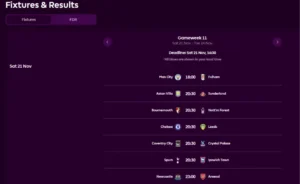
Official Fantasy Premier League fixture calendar showing scheduled matches and Gameweek information for the 2026/27 season.
These dates indicate the approximate Gameweek periods, not confirmed FPL deadlines or confirmed rearranged fixtures.
There is also a less likely possibility of disruption around GW37 if the FA Cup final creates a conflict with a European final involving one of the participating clubs.
The important distinction is that these are potential scheduling windows, not guaranteed Double or Blank Gameweeks.
A predicted double might not materialise, and some rearranged matches could be placed in different Gameweeks depending on television scheduling, cup progression and available midweek dates.
Our assessment is that managers should treat these projections as early planning signals rather than instructions to make immediate transfers.
Important: Do not label a projected Gameweek as confirmed unless its rearranged fixtures appear in the official schedule.
Why Do Double and Blank Gameweeks Happen?
Most Double and Blank Gameweeks develop because Premier League fixtures clash with other competitions.
EFL Cup Final
The EFL Cup final is scheduled during the GW30 period. If a finalist’s Premier League match cannot take place as originally planned, that fixture may need rearranging.
Both teams involved in the affected Premier League match could therefore receive a blank, even if only one of them is participating in the cup final.
FA Cup Semi-Finals
The FA Cup semi-finals are scheduled for the GW33 weekend.
Clubs reaching this stage may need to have their Premier League matches moved. Their scheduled league opponents could also lose a fixture during that Gameweek.
This creates an important planning consideration: a team does not have to participate in a cup competition to be affected by a Blank Gameweek.
Other Unexpected Postponements
Bad weather, safety concerns, stadium availability and other exceptional circumstances can also cause fixture changes.
Furthermore, European competition commitments can reduce the number of available midweek dates for rearranged games.
A fixture postponed unexpectedly may later create a Double Gameweek outside the currently anticipated windows.
How Do FPL Points Work During a Double Gameweek?
In a Double Gameweek, an eligible player earns points from both Premier League fixtures, subject to the usual Fantasy scoring rules.
Consider the following hypothetical example.
| Match | Player’s FPL points |
| First Premier League fixture | 6 |
| Second Premier League fixture | 9 |
| Total DGW score | 15 |
| As normal captain | 30 |
| With Triple Captain | 45 |
If the same player earns 15 points across two fixtures, selecting them as captain produces 30 points. Activating Triple Captain increases the captain’s score to 45 points.
This illustrates why Double Gameweeks are attractive for managers holding premium attackers.
However, two scheduled fixtures do not guarantee two appearances.
A player could start the first match, be rested for the second or miss both through injury.
Consequently, a player expected to start twice is generally more attractive than an equally priced alternative who is likely to play only once.
For defenders, two fixtures may also mean greater exposure to goals conceded, reducing clean-sheet opportunities.
Our key consideration: Double Gameweek value should be judged through expected minutes, fixture difficulty and attacking or defensive potential, rather than fixture quantity alone.
Which Teams Should FPL Managers Target for Double Gameweeks?
There is no confirmed list of clubs with upcoming Double Gameweeks for the 2026/27 season at the time of writing.
That makes it premature to recommend specific teams solely because they might have two matches later in the campaign.
Instead, we recommend evaluating four important factors once postponements and rearrangements are announced.
1. Quality of the Opposition
Two difficult fixtures against strong opponents may be less attractive than one favourable home match.
Consider the defensive record, recent form and home-away performance of both opponents.
2. Expected Playing Time
Regular starters have a greater opportunity to benefit from additional fixtures.
A player who consistently completes 80–90 minutes may offer more predictable returns than one frequently substituted after an hour.
3. Attacking Involvement
For midfielders and forwards, review expected goals (xG), expected assists (xA), penalty responsibilities and recent involvement in attacking moves.
For defenders, consider clean-sheet potential alongside opportunities for assists, goals and defensive contributions.
4. Fixtures After the Double
A player with two good matches followed by several favourable Gameweeks may represent better value than a short-term purchase who immediately faces difficult opponents.
This is particularly important for managers without a Wildcard available to restructure their squads afterwards.
What Is the Best Strategy for FPL Blank Gameweeks?
A Blank Gameweek creates a different challenge because some players have no opportunity to score.
The main objective is to maintain a competitive starting XI without damaging your squad for future Gameweeks.
Before making transfers, count how many of your players are realistically expected to play.
For instance, suppose six members of your 15-player squad belong to clubs without fixtures.
That does not automatically mean you need six transfers. Some blanking players may already be on your bench, and you only need enough available players to field a competitive XI.
Consider the following approaches.
| Available starters | Possible approach |
| 10–11 | Usually manageable through normal selection |
| 8–9 | Consider free transfers and selective adjustments |
| 6–7 | Assess whether Free Hit offers significant value |
| Fewer than 6 | A Free Hit could become particularly attractive |
These are practical guidelines, not fixed rules.
The strength of available players matters just as much as the number. Eight excellent starters with favourable fixtures may outperform eleven weak options.
Another consideration is whether blanking players have rearranged fixtures later. Selling valuable assets to solve one blank can create an expensive rebuilding problem when their Double Gameweek arrives.
Sometimes, keeping a premium player on the bench for one round is the more effective long-term decision.
How Should You Use FPL Chips in the 2026/27 Season?
The chip system is one of the most important aspects of Double and Blank Gameweek planning.
For 2026/27, Fantasy Premier League managers receive two sets of four chips: Wildcard, Free Hit, Bench Boost and Triple Captain.
One set is available during the first half of the season and another during the second half.
The first set must be used before the GW19 deadline, while the second set becomes available from GW20. Unused first-half chips do not carry over.
Only one chip can be activated for a Gameweek.
These rules are confirmed in the Premier League’s official 2026/27 chip guidance.
| FPL chip | What it does | Potential strategic use |
| Wildcard | Unlimited permanent transfers | Rebuild a squad before a favourable fixture run |
| Free Hit | Unlimited transfers for one Gameweek | Navigate a major blank without permanent changes |
| Bench Boost | Adds substitutes’ points to your total | Benefit from a strong playing bench |
| Triple Captain | Triples captain points | Target a reliable high-scoring player |
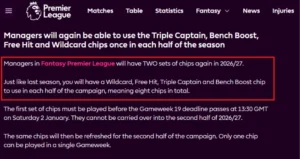
Premier League explanation of the 2026/27 FPL chip rules and how they can support Blank and Double Gameweek planning.
When Should You Use the Free Hit?
A Free Hit is particularly useful when several of your best players have no fixture.
It allows you to select a temporary squad for the current Gameweek without permanently losing players who may be valuable afterwards.
However, Free Hit can also be useful in a Double Gameweek if your existing squad cannot take advantage of the additional fixtures.
The deciding factor should be the expected improvement over your normal team.
Is Bench Boost Better During a Double Gameweek?
Bench Boost is often associated with large Double Gameweeks because all 15 squad members can contribute to your points total.
But you do not need 15 players with two fixtures to make it worthwhile.
A strong bench consisting of four regular starters with good single fixtures could outperform a bench containing rotation-prone players with doubles.
Check that your substitute goalkeeper, defenders, midfielders and forwards are fit and likely to play before activating the chip.
Should You Save Triple Captain for a Double Gameweek?
Triple Captain can deliver excellent returns when used on an attacker expected to play two favourable matches.
Nevertheless, saving it for a double is not automatically the best strategy.
A premium attacker facing an excellent single opponent may offer better value than someone with two difficult matches and uncertain minutes.
Captaincy should reflect the player’s expected total points, not simply the number of fixtures.
When Does a Wildcard Make Sense?
A Wildcard provides permanent squad changes and is useful when your team requires a significant overhaul.
For managers targeting a late-season double, playing a Wildcard beforehand can help build a squad with strong fixtures over several weeks.
For a detailed explanation of activation rules and transfer planning, read our FPL Wildcard rules and strategy guide.
Remember that the Wildcard and Bench Boost cannot be activated together in the same Gameweek. A common approach is to rebuild the squad first and use Bench Boost in a subsequent round.
How Can You Plan Transfers Across Multiple Gameweeks?
One of the most common mistakes in FPL is focusing exclusively on the next deadline.
Double and Blank Gameweeks often affect several rounds, making a multi-week strategy more effective.
Managers can accumulate up to five free transfers under the current rules. This creates greater flexibility when planning for fixture changes.
Consider a hypothetical sequence involving a blank in GW30, a double in GW32 and another blank in GW33.
Before GW30: Check your available players
Identify which teams might miss a fixture and assess whether your squad needs changes.
If you can already field a strong XI, avoid unnecessary transfers.
GW30: Protect your team from the blank
Use free transfers to address genuine problems, or consider Free Hit if the expected points improvement justifies using the chip.
Do not automatically sell every blanking player.
GW31: Review confirmed rearrangements
Once fixtures are confirmed, identify players with favourable doubles and assess their expected minutes.
Consider whether a Wildcard would improve your team beyond one Gameweek.
GW32: Target strong Double Gameweek opportunities
If confirmed doubles take place, prioritise reliable players with good opponents.
Review captaincy carefully and consider your available chips.
GW33: Prepare for another possible blank
Avoid building a GW32 squad that could leave you unable to field a competitive team in GW33.
This is why planning across multiple Gameweeks matters more than simply buying as many double-fixture players as possible.
GW35–36: Reassess late-season opportunities
As the campaign approaches its conclusion, compare rearranged fixtures with possible rotation, European commitments and clubs’ remaining competitive objectives.
Late-season team news becomes especially important.
Are Transfer Points Hits Worth Taking During Double Gameweeks?
Managers sometimes make additional transfers before a Double Gameweek because they expect the incoming players to score more points.
However, each transfer beyond your available free transfers normally costs four points.
To determine whether a points hit is worthwhile, compare the expected return of the incoming player with the player being replaced.
Suppose:
- Your current player is expected to score 5 points.
- A new Double Gameweek player is expected to score 10 points.
- The transfer costs 4 points.
The expected immediate advantage is:
10 − 5 − 4 = 1 point
That is only a small expected improvement, despite the incoming player having two fixtures.
If the Double Gameweek player is likely to continue performing well in subsequent rounds, the transfer may still provide long-term value.
On the other hand, a player who is expected to score 7 points instead of 5 would produce a net expected loss of two points after the transfer penalty.
This approach helps prevent unnecessary hits caused by excitement around extra fixtures.
We recommend taking a hit only when there is a credible expected benefit across the relevant planning period, rather than assuming two matches will automatically justify the cost.
Why Can Double Gameweek Players Still Disappoint?
Having an additional fixture does not eliminate the normal risks associated with Fantasy Premier League.
In some cases, Double Gameweek players can actually present more uncertainty.
Squad rotation: Managers may rest players between matches, especially when their clubs are involved in several competitions.
Injury and fatigue: A congested schedule can increase physical demands and reduce the likelihood of players completing both fixtures.
Difficult opposition: Two fixtures against strong defensive teams may offer fewer opportunities than one favourable match.
Reduced minutes: A player who starts one match and makes a brief substitute appearance in the other may have less value than anticipated.
Poor team form: Extra fixtures cannot compensate for a team consistently struggling to create chances or defend effectively.
The strongest Double Gameweek selections combine good fixtures with predictable involvement and solid underlying performance.
How Do You Check Confirmed Double and Blank Gameweeks?
Fixture predictions are useful for early planning, but your final decisions should be based on official scheduling announcements.
Follow these steps.
Step 1: Open the official FPL fixtures calendar
Select the upcoming Gameweeks and examine how many league fixtures each club is scheduled to play.
Step 2: Check for rearranged fixtures
When the Premier League confirms a postponement or a new date, inspect which FPL Gameweek contains the affected match.
Step 3: Identify blanks and doubles
A team with no listed Premier League fixture has a blank in that Gameweek. A team with two eligible fixtures has a double.
Step 4: Review player availability
Confirm injury updates, suspensions and expected starting line-ups before making transfers.
Step 5: Recheck before the deadline
Fixture announcements can change your preferred transfer or chip strategy. Reassess the situation close to the official FPL deadline.
How to identify confirmed Double and Blank Gameweeks using the official Fantasy Premier League fixture list.
Note: If no relevant rearrangement has been confirmed at publication, use a normal fixture-calendar screenshot instead and replace it when the schedule changes.
What Are the Biggest Mistakes to Avoid During FPL Doubles and Blanks?
Even experienced Fantasy managers can lose points through poor planning.
The most important mistakes to avoid are:
- Treating predicted fixtures as confirmed. Do not commit transfers based solely on possible cup-related postponements.
- Buying too many Double Gameweek players. Consider the quality of their opponents and their expected playing time.
- Taking excessive transfer hits. Calculate the expected points improvement before accepting deductions.
- Ignoring future blanks. A team with a Double Gameweek might also have a blank in a nearby round.
- Forgetting the chip deadlines. First-half chips expire at the GW19 deadline and cannot be saved for the spring.
- Using Bench Boost with weak substitutes. Prioritise the reliability and scoring potential of your bench rather than simply the number of scheduled matches.
The central principle is to manage your entire squad across several Gameweeks instead of chasing one potentially high-scoring round.
Conclusion
FPL Double and Blank Gameweeks offer opportunities to improve your Fantasy Premier League ranking, but effective planning is more important than simply targeting extra matches.
For the 2026/27 campaign, GW30 and GW33 are potential blanks, while GW32 and GW35–36 could provide opportunities for doubles. These remain predictions until fixture changes are officially confirmed.
The strongest approach combines careful transfer planning, reliable player selection, realistic points expectations and timely chip usage.
By preparing several Gameweeks in advance and regularly reviewing the official fixture calendar, managers can minimise the disruption caused by blanks and make better use of future Double Gameweeks.
Frequently Asked Questions About FPL Double and Blank Gameweeks
When Is the Next FPL Double Gameweek in 2026/27?
As of 19 November 2026, no future Double Gameweek has been officially confirmed. GW32, GW35 and GW36 are potential scheduling windows, but the actual arrangements will depend on fixture postponements and confirmed rescheduling.
Which FPL Gameweeks Could Be Blank in 2026/27?
GW30 and GW33 are the main predicted Blank Gameweeks because they overlap with the EFL Cup final and FA Cup semi-finals. However, the clubs affected will only become clear as cup competitions progress.
Can You Use Free Hit and Bench Boost in the Same Gameweek?
No. FPL allows only one chip to be used in a Gameweek. Managers must choose between Free Hit, Bench Boost, Triple Captain and Wildcard depending on their squad’s needs.
Does a Captain Score Double Points in Both Double Gameweek Fixtures?
Yes. If your captain plays twice, their Fantasy points from both eligible Premier League matches count towards their Gameweek total and are doubled. Triple Captain triples the combined captain score instead.
Should You Sell Players Who Have a Blank Gameweek?
Not necessarily. If a blanking player has strong upcoming fixtures or a possible future double, keeping them may be more beneficial. Consider your available bench players, free transfers and long-term squad requirements.
Is It Better to Use Bench Boost or Triple Captain in a Double Gameweek?
Bench Boost may offer more value when you have a strong squad of 15 available players. Triple Captain may be preferable when one premium attacker has particularly favourable fixtures and a high likelihood of starting both matches.