
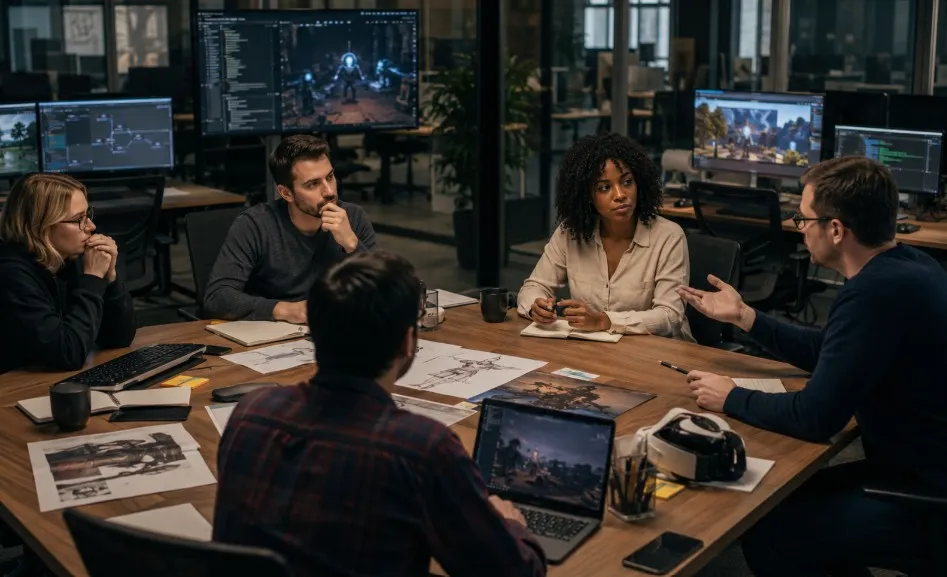
A poor hiring choice affects an entire game project. Teams looking to hire game developers in 2026 encounter a market full of freelancers, outsourcing vendors, co-development teams, and full-cycle studios. Depending on your specific case, each model may work. But it’s only relevant when technical skills, production workflow, and communication standards fit your project goals.
The major risk isn’t even hiring people who lack Unity, Unreal, mobile, multiplayer, or live ops experience. It’s hiring a team without clear ownership of delivery. In this article, we look at widespread hiring mistakes and viable ways to evaluate game developers for your project.
Why Hiring Game Developers Has Become More Challenging in 2026?
New Technologies
The technical expectations from game developers keep growing. Whether a mobile title, an online multiplayer game, or a PC or console release, every project requires different engines, backend services, optimization strategies, and testing methods. Teams that often deal with similar projects can spot technical risks earlier. It reduces costly changes later in development.
Global Talent
These days, many studios turn to remote collaboration. With such flexibility, companies have more options when searching for game developers for hire. Yet it also increases the importance of well-established communication.
Time zone overlap, response times, documentation, and project management habits are among the key factors that influence delivery no less than technical skills.
Evolving Development Models
Many studios provide more than just programming services. One partner may offer engineering, art production, QA, DevOps, LiveOps, post-launch updates, and more.
That’s why companies evaluating a game studio for hire should consider lots of aspects, not just hourly rates. It makes sense to compare how each vendor plans work, reports progress, and adjusts to changes in project requirements.
The Most Common Mistakes Companies Make When Hiring Game Developers
Overlooking Technical Expertise
Technical skills sometimes get less recognition than things like portfolio visuals and hourly rates. Unfortunately, a polished trailer or attractive screenshots can’t reflect code quality, optimization, multiplayer architecture, or build stability.
With that in mind, before you hire a game development team, ask how developers solved technical challenges on their previous projects. Also, take into account what engines they specialize in.
Finally, their approach to testing and performance optimization is also crucial. Practical experience reveals much more than a list of technologies.
Communication
Good tech skills can’t compensate for poor collaboration. In particular, delayed responses, unclear documentation, and inconsistent progress updates may lead to more issues than programming challenges.
A brief discovery phase will probably reveal how a team organizes meetings. Besides, it will show how they track tasks and communicate risks before you hire a video game developer and the development process kicks off.
Portfolio Quality
Finished game projects give you more useful insights than impressive marketing materials. Seek released titles, platform compatibility, technical complexity, player reviews, and post-launch support. Such details expose whether a studio can deliver a reliable production process, from planning to release.
How to Choose the Right Game Development Partner?
1. Evaluate Experience
Proper experience is even more critical than the total number of completed projects. For instance, a studio that specializes in multiplayer games may not be your go-to for a narrative mobile title. Meanwhile, a team focused on casual games could have limited experience with console certification or live-service infrastructure.
So, before you hire a game development team, compare previous projects with yours. Consider genre, platform, production scale, and technical requirements. Similar experience reduces onboarding time and allows teams to detect risks early on.
2. Workflow Transparency
A trustworthy development partner explains how the team plans, reviews, and delivers work before production launches. Ask how they organize milestones, how often the team reports progress, and who becomes your point of contact. Thanks to clear workflows, it’s easier to track development, approve outputs, and discover possible delays before they influence your expected release schedule.
3. Long-Term Collaboration
Successful games should grow after launch. For that, updates, new content, balance changes, and technical maintenance are vital. Choosing a partner with long-term support capabilities will facilitate future development.
Besides, it will reduce the time needed to onboard another team. So, when you hire game developers, discuss post-launch plans during contract negotiations instead of addressing them as an individual project.
Best Practices for Hiring Game Developers Successfully in 2026
Hiring decisions have an enduring impact on development costs, production speed, and game quality. When selecting a partner, determine your technical requirements.
Also, look at similar projects and discuss how you’ll manage development from the first milestone to launch. Don’t rely only on portfolios or pricing. Ask practical questions that clarify communication, testing, reporting, and post-release support.
Finally, if you plan to hire a mobile game developer for a long-term project, look for a team with technical expertise and a well-structured production approach. Solid collaboration depends not only on transparency and shared expectations but also on programming skills. Take your time to evaluate both areas. Thus, development will be more likely to stick to the defined schedule.